内容概要
Cobot welding is worth investigating when a recurring bracket family can be presented consistently and accepted welds can be produced with less total batch effort. Pilot one bounded family, with a competent welding specialist and integrator responsible for process approval and cell safety. Measure preparation, loading, inspection and rework alongside welding time.
Select a family that earns its setup effort
Start with production history rather than the most impressive sample on the sales table. Select brackets that recur often enough for fixtures and approved programs to be reused. Record drawing revision, material, joint arrangement, batch quantity and the expected time before the job returns. Separate stable repeat work from prototypes whose holes, bends or weld locations are still changing. Frequent engineering changes can consume the time that automation was intended to release.
Prepare a baseline batch record covering component preparation, fit-up, tacking where required, welding, cooling, inspection and correction. Record both elapsed time and labour attendance; an operator can be occupied without the arc being on. Interview the person who currently makes the brackets about adjustments that never appear on the drawing. The pilot should expose those adjustments so the team can decide whether to control them upstream or accommodate them in the cell.
Measure joint variation before teaching a path
Collect components from different normal production batches, including acceptable extremes of bend position, edge condition and mating geometry. Have the welding specialist identify the characteristics that affect the approved process. Photograph and measure the assembled joint as well as the loose pieces. A robot returning to the same coordinates cannot establish that a changing joint is suitable for the same welding procedure.
Separate part-location error from torch-reference error during troubleshooting. Miller's Copilot manual OM-296940B, dated April 2024, describes tool-centre-point checking and warns that fixture or part repeatability can still cause a path problem when torch alignment is correct. Use that distinction as a diagnostic question for the supplier. Request an application-specific method for checking both references after tooling work; do not copy that manual's physical procedure onto a different welding system.
参考资料: Copilot Collaborative Welding System, OM-296940B, April 2024
Make the fixture practical to load and maintain
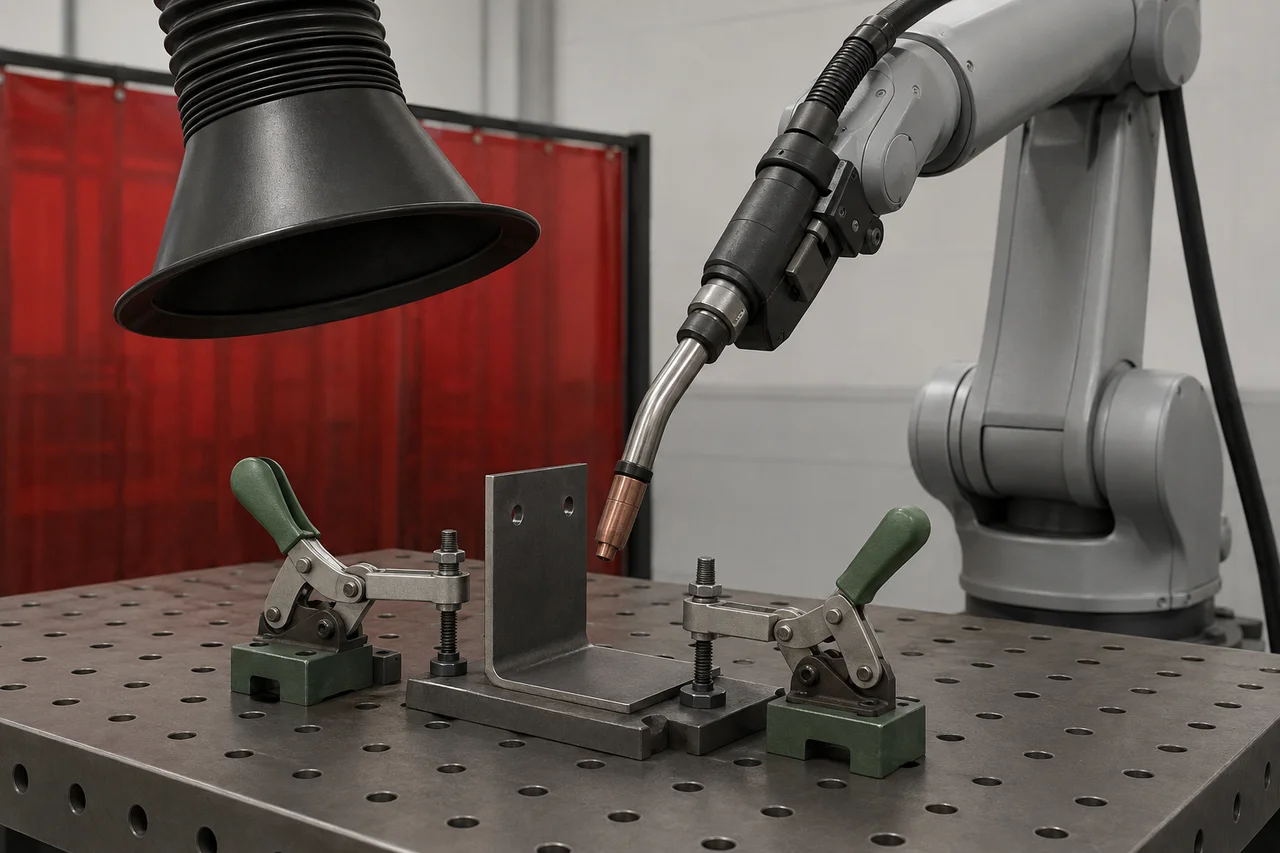
Ask the fixture designer to show how each component locates, how incorrect orientation is prevented or detected, and how the torch reaches every required joint without clashing with clamps. Include the cable envelope and the exit motion after welding. A nest that locates beautifully but traps the completed bracket or obstructs inspection is not a production solution. Confirm that the qualified team has considered thermal movement and the order in which clamps are released.
Use a small fixture comparison before committing to a large multiposition tool. The following are trial questions, not prescribed construction details. Include the time to clear spatter, replace locating elements and verify the fixture after maintenance in the supplier's proposal. Retain identifiable sample parts so a later problem can be compared with the condition under which the fixture was accepted.
| Fixture question | Evidence to request | Production consequence |
|---|---|---|
| Can parts seat consistently? | Trial with normal batch variation | Avoid repeated manual adjustment |
| Can the torch reach each joint? | Reviewed full path and cable envelope | Avoid inaccessible welds |
| Can a hot bracket be removed? | Qualified handling and release review | Avoid blocked unloading |
| Can worn locators be replaced? | Identified parts and reference checks | Preserve repeatability after service |
Approve the weld, not its appearance alone
Define acceptance with the responsible welding and quality personnel before the first trial. They should identify the applicable drawing requirements, procedure controls, inspection methods and any qualification obligations for the actual product. Agree which samples require additional examination and who can approve the result. A neat bead in a demonstration video cannot establish internal quality, required dimensions or fitness for the bracket's eventual service.
Keep the weld procedure and robot program as related but separate controlled records. Capture the power-source configuration, consumable identity, fixture revision and program revision for each trial group. Record rejected outcomes even when a technician corrects them immediately. When a change improves appearance but increases distortion, the quality record should preserve both observations. Make the acceptance decision using the complete product requirements rather than choosing whichever result favours automation.
参考资料: Copilot Collaborative Welding System, OM-296940B, April 2024
Plan exposure control and access together
Automating the torch does not remove welding fume, arc radiation, hot material or fire hazards. HSE's welding guidance calls for assessment of the process and exposure, with suitable controls such as local exhaust ventilation. It also addresses nearby workers and arc screening. Have competent specialists design and verify controls for the proposed fixture positions, loading arrangement and working environment before production trials.
The robot integrator must assess the complete application, including setup and foreseeable recovery. Keep fume controls and robot protective measures on the same layout so one does not obstruct the other. For example, a hood position that controls exposure may affect torch access, while a screen can affect visibility during loading. Resolve these interactions through the responsible designers. A cobot label is not permission for an operator to enter an active welding area.
参考资料: Controlling the risks from welding · UR5e Risk Assessment, PolyScope 5.19 manual
Work through a complete hypothetical batch
Suppose a fictional shop makes 60 identical brackets. Its measured manual baseline is assumed to be 8 minutes of labour per accepted bracket, or 480 minutes. A proposed pilot assumes 90 minutes of batch setup, 3 minutes of attended handling per bracket and 45 minutes of inspection and routine torch care. That totals 315 labour minutes before rework, leaving an illustrative difference of 165 minutes. These are arithmetic assumptions, not observed cobot performance.
Now assume the batch is only 15 brackets with the same setup and shared support time. The proposed attendance becomes 180 minutes against a manual baseline of 120 minutes. The result reverses before any purchase cost is considered. Keep elapsed batch completion separate: welding and loading may overlap only where the engineered station allows it. Use the pilot to replace each assumption and establish a family-specific batch threshold.
Include the interruptions a normal week contains
Schedule more than one run after the first successful setup. Include a return to the bracket family after another job, a routine consumable change and representative component replenishment. The authorised team should manage these events through the established operating procedures. Record whether production resumes using the documented setup or requires the supplier to reteach unexplained offsets. Repeatability across setups matters especially when batches are small and separated by days.
Track reasons for attendance: replenishment, tip care, fixture cleaning, inspection, alarm diagnosis and quality decisions. Do not combine them into an unexplained downtime number. Ask the supplier to identify which work a trained operator can perform and which needs a specialist. Stop a test when its agreed safety or quality boundary is exceeded; preserving a failed run is more useful than silently changing the conditions to finish it.
Decide whether to expand, revise or stop
End the pilot with accepted output, total attendance, elapsed batch time, rework, changeover effort and unresolved dependencies for the selected family. Compare the result with the original production baseline under comparable conditions. A worthwhile result may be more predictable delivery or reduced repetitive attendance rather than a faster arc cycle. Name the benefit and explain how the shop would actually use the capacity released.
Expand only to bracket variants whose differences have been reviewed. A larger assembly can change torch access, fixture behaviour and exposure even when the weld looks similar. If variation remains the limiting factor, consider improving upstream cutting or bending before buying more automation. Preserve the approved configuration, inspection evidence and reasons for the decision so the pilot becomes a reusable production record rather than a successful afternoon that nobody can reproduce.
检查清单
- Choose a recurring bracket family and controlled drawing revision.
- Record normal joint variation from more than one batch.
- Review fixture loading, torch access and hot-part removal.
- Agree weld acceptance with competent welding and quality personnel.
- Verify exposure controls and the complete cell's protective measures.
- Measure attendance, elapsed time, changeover and rework separately.
- Record the conditions that justify expansion to another variant.
常见问题
Does a cobot replace the need for a skilled welder?
It can automate a repeatable torch path, but the shop still needs competent people to establish the process, judge joint suitability, interpret defects and approve changes. Include that retained expertise in the pilot's staffing and cost model.
Should the first pilot include seam tracking?
Only when a measured application problem justifies it. First distinguish inconsistent fit-up, fixture location and torch-reference errors. Ask the supplier to demonstrate what its proposed sensing can detect and correct on your joint family, including failure cases and the added setup time.
参考资料: Copilot Collaborative Welding System, OM-296940B, April 2024
来源与审核
Documentary pilot guidance checked on 6 September 2026; no hands-on welding tests were performed. Miller OM-296940B is a dated reference, not a procedure for other systems. Welding and cell approval require competent personnel.
适合读者:Fabrication shops considering repeat-bracket automation. 更新于 .
- Copilot Collaborative Welding System, OM-296940B, April 2024
- Controlling the risks from welding
- UR5e Risk Assessment, PolyScope 5.19 manual