内容概要
Build the schedule from the manuals and service requirements for the actual robot, controller, tooling and connected equipment, then have competent personnel adapt inspection planning to the site's risks and operating history. Each task needs a trigger, authorised method, responsible role, evidence and response to a defect. A generic calendar cannot establish suitable intervals for every cell.
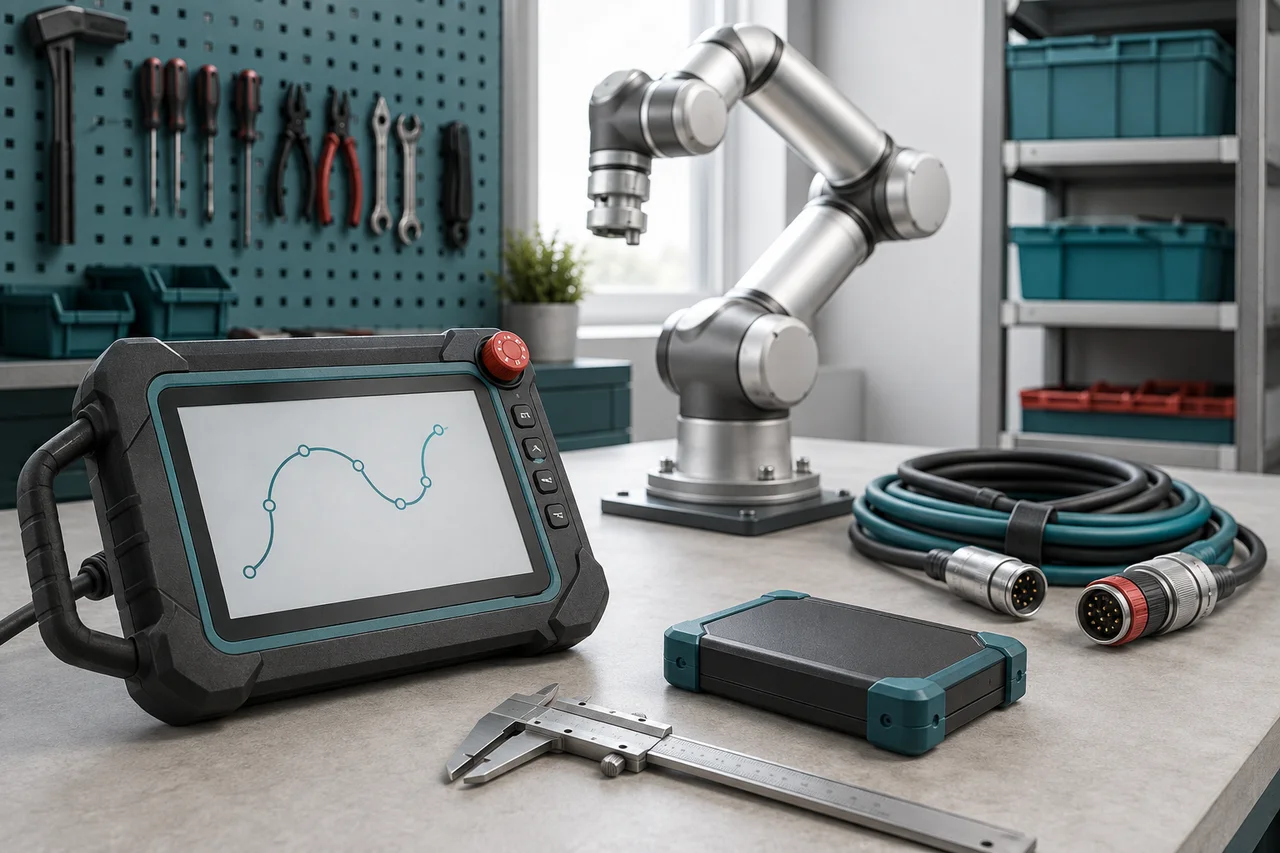
Identify every asset before choosing tasks
Create an equipment register covering the arm, controller, pendant, end effector, tool changer, fixtures, conveyors, external axes and protective equipment. Include process equipment such as a welder or vacuum system where relevant. Record model, serial identity, installation location and the current configuration. A robot may be healthy while a worn cup, blocked filter or damaged cable makes the application unreliable.
Assign an owner to each asset and identify where its service information lives. Keep robot-arm tasks distinct from application-specific tasks so a contractor's completed arm service cannot be mistaken for a completed cell inspection. Link the register to the accepted layout and configuration. When a tool is exchanged between cells, its maintenance identity should move with it rather than becoming an untracked accessory.
Match documents to the actual hardware and release
Obtain the manufacturer's applicable user and service information for each asset, including hardware generation and controller software release where relevant. Record document title, revision, issue date, source and the person who confirmed applicability. A manual for a neighbouring robot model is not a substitute. Where the manufacturer has replaced a document, preserve the previously used revision and record which tasks changed under the new one.
Universal Robots' public inspection page separates e-Series and UR20/UR30 material and points readers to service documentation. Its displayed last-modified date is 2 July 2020, even though the available page includes newer product families. That is a reason to confirm applicability with current model-specific service information. Use the page as a route to manufacturer guidance, not as a universal interval chart or authority to carry out a procedure on another system.
Separate observation, inspection and maintenance
Different tasks need different competence and control. An operator may be trained to report visible damage from an authorised position, while internal electrical work or joint repair needs a different qualification and method. Keep routine observation, formal inspection, planned servicing and corrective repair as distinct task types. Do not give them the same checkbox or imply that noticing a problem authorises the observer to repair it.
HSE's inspection guidance ties the need and frequency of inspection to risk, manufacturer recommendations and experience. It also describes competence through understanding what to examine, what to look for and what to do about a finding. Use those questions when assigning roles. A person can be competent for an external inspection without being competent for every repair that inspection might reveal.
Translate source triggers into usable work orders
Copy the applicable trigger faithfully: calendar time, operating hours, cycles, condition or a specified event. Record which counter or date supplies the evidence and how the next due point is calculated. If a task has more than one trigger, preserve the manufacturer's relationship between them. Do not silently convert a runtime requirement into an annual reminder or postpone a calendar task because production has been quiet.
Each work order should identify the source section, permitted method, competence requirement, required equipment, completion evidence and action on failure. The table is a schedule structure with deliberately unspecified intervals. Populate them from the actual documents and approved assessment. Include a field for work that is due but cannot proceed because access, parts or qualified staff are unavailable; an unresolved task must not look completed.
| Task record | Trigger source | Completion evidence |
|---|---|---|
| Arm and service-cable inspection | Applicable manual and site assessment | Observed condition and defects |
| Tooling wear or consumable task | Tool manufacturer's instructions | Part identity and work record |
| Protective-function verification | Approved validation and inspection plan | Authorised test result |
| Controller service task | Controller-specific documentation | Recorded method and outcome |
| Post-incident review | Defined incident procedure | Disposition and release decision |
Prepare maintenance as controlled work
HSE's maintenance guidance calls for competent people and planned arrangements for safe work. Have the responsible team define isolation, stored-energy control, access and support for the actual task and equipment. A stopped program is not itself an isolation method. Where a diagnostic activity needs energised equipment, it requires the specific authorised procedure and protective arrangements; a general guide cannot supply those conditions.
Schedule the people, access window, parts, tools and any approved lifting arrangements together. Confirm contractor responsibilities and how work on connected machines is coordinated. Record the condition in which the cell is handed over for work and who controls it. Keep production pressure out of the technical decision about whether a task can proceed. If the documented method cannot be followed, escalate for a competent alternative before starting.
Adapt inspection planning to duty with evidence
Track operating environment and use: shifts, contamination, coolant exposure, abrasive dust, tool changes and repeated handling of difficult loads can inform the review. Compare findings against the conditions assumed when the plan was created. HSE notes that inspection frequencies can be reviewed in light of experience. That supports a competent review of evidence, not an informal extension of a manufacturer's required service limit to save downtime.
Consider a hypothetical cell moved from clean assembly to handling coolant-wet components. Its asset identities may be unchanged, but the maintenance lead now records contamination at the tool and service routing. The appropriate response is to review compatibility, protective arrangements and inspection needs with the relevant specialists, then document any approved changes. Simply increasing cleaning frequency may fail to address an unsuitable component or a new exposure path.
Record findings and control return to service
Require more than a completion tick. Record who performed the work, when, which method was used, observations, measurements where applicable and replaced-part identities. Attach photographs only when they help identify a finding or establish the completed condition. Preserve unsuccessful checks and cancelled tasks. An honest incomplete record is more useful than a green dashboard that hides a failed inspection.
Give each defect a disposition from the responsible competent person: repair required, further examination, restriction under an approved arrangement or release where justified. Identify who can authorise return to service and which verification follows the work. Configuration changes may require checks beyond the repaired component. Keep the restored program and settings aligned with the accepted cell record, using the separate backup-and-recovery process where relevant.
Review the schedule against repeated findings
Use maintenance history to distinguish an isolated worn item from a recurring design or operating problem. Repeated cable damage may justify review of routing and movement rather than repeatedly buying the same cable. A fixture that drifts after every tool change may need a setup or locating review. Assign these recurring issues to an engineering owner with a recorded decision, instead of treating each visit as an unrelated repair.
Review overdue tasks, unresolved defects, spare availability and the quality of completion records at a cadence appropriate to the site. Measure whether important findings are closed and whether repeat faults reduce; a high number of completed tasks alone does not establish effectiveness. Update the plan after relocation, significant equipment changes or new manufacturer information. Retain the revision history so the next maintenance lead can explain why each task exists.
检查清单
- Register the arm, controller, tooling and connected equipment separately.
- Match each task to an applicable document and revision.
- Distinguish operator observation from specialist inspection and repair.
- Preserve calendar, runtime, condition and event triggers accurately.
- Assign competence, authorised methods and defect responses.
- Prepare access, isolation and resources through the responsible team.
- Record findings and replaced parts, including failed or deferred work.
- Require documented return-to-service authority and review recurring faults.
常见问题
Can I use the same monthly checklist for every robot?
You can reuse the record format, but not assume identical tasks or intervals. Populate each schedule from the applicable manuals, configuration and competent site assessment. Different tools and environments can require different attention even on matching robot arms.
参考资料: Inspection of work equipment · Inspection and Maintenance Plan
Does a low-hours robot need no maintenance?
No. Some tasks depend on calendar time, storage conditions or deterioration rather than motion hours. Preserve the manufacturer's actual triggers and have competent personnel review the equipment's history before returning it to use.
Should an operator clear a defect immediately?
Only within the work they are trained and authorised to perform using the approved procedure. Otherwise report it and follow the site's defined equipment-status and escalation process. Finding a defect does not automatically confer repair competence.
来源与审核
Planning guidance checked on 6 September 2026; no universal maintenance intervals or repair procedures are supplied. Confirm current manuals for each asset. The UR overview's displayed modification date does not establish revision currency.
适合读者:Workshop maintenance leads responsible for complete robot cells. 更新于 .
编辑方针 · 提交勘误