内容概要
Choose actuation after defining the contact geometry and required product changes. Electric control can be useful when opening, force settings or feedback must vary by recipe. Pneumatic actuation can fit a repeated motion with suitable air infrastructure. Compare exact models, their service-loss behaviour and the complete installed system before deciding.
Write the control problem before choosing a drive
List what the gripper must change between products: contact position, opening distance, closing behaviour, holding setting or only an identifier in the job record. Separate continuous adjustment from a handful of known recipes. A device with many parameters offers little value if every batch uses the same fingers and movement. Conversely, a simple close command may leave unnecessary mechanical adjustment in a frequently changing process.
Festo's 2020 overview contrasts common pneumatic and electric arrangements. Use it for the basic distinction, not as a present-day ranking of mass, speed or cost across all products. Current candidate data must settle those comparisons. Ask for a functional demonstration of each required setting and status, using the exact gripper, interface and controller combination being quoted.
参考资料: Get a Handling on Grippers, 2020 white paper · EGU 50-PN-M-B, product ID 1491537
Compare functions at the same system boundary
Two quotations may describe different boundaries. One might include valves, sensors and ready-made robot software, while another gives only the actuator. The comparison becomes useful when both suppliers fill in the same schedule. Mark a capability as included, optional, externally provided or unavailable. Do not infer proportional control from the presence of a regulator, or assume that every electric unit exposes every internal measurement.
Use the table to organise the enquiry. These are application questions, not promises associated with either energy source. A supplier may propose a pneumatic solution with sophisticated sensing or an electric solution operated through simple digital commands. What matters is the behaviour the integration team can actually command, observe and maintain.
| Decision | Pneumatic proposal | Electric proposal |
|---|---|---|
| Variant change | Valve, regulator and sensor changes required | Supported position and force recipes |
| Wrist services | Air quality, flow, pressure and tubing | Supply, transient demand and communications |
| Grip retention | Valve state, stored energy and mechanical retention | Drive or mechanism retention and recovery |
| Feedback | Exact sensors and what they detect | Exposed statuses and their documented meaning |
| Ownership | Air infrastructure, wear and service labour | Electronics, software and service labour |
参考资料: Get a Handling on Grippers, 2020 white paper · EGU 50-PN-M-B, product ID 1491537
Trace utilities all the way to the tool
For a pneumatic proposal, have the supplier specify the required air condition at the tool during its operating sequence. A compressor nameplate does not describe delivery through regulators, valves, fittings and moving tubing. Ask where pressure is assessed and which other consumers share the supply. Include venting, isolation and stored-energy arrangements in the qualified integration design, with an identified owner for each component.
For an electric proposal, check the power and communication requirements against the actual robot connection. Cable strain relief, connector access and replacement routing are part of the installation. Confirm whether the available interface exposes the required commands and diagnostics. A nominally compatible voltage does not establish that the wrist supply can support the tool's complete electrical demand or that the offered software supports the installed firmware.
参考资料: EGU 50-PN-M-B, product ID 1491537 · Maintenance of work equipment
Compare usable contact behaviour, not maximum force
A force setting is useful only when it produces an acceptable interaction with the part. Ask about available adjustment, closing approach and the definition of the reported value. Determine whether the interface exposes a command, an estimate or a measured quantity. Then inspect the effect at the proposed fingertips. Differences in geometry and contact compliance can change the result even when the actuator settings have familiar names.
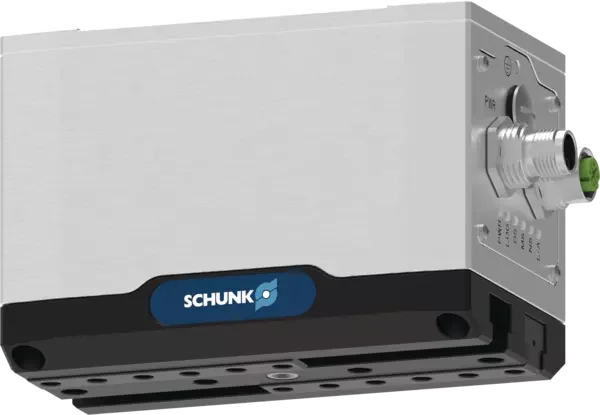
The SCHUNK EGU 50-PN-M-B page, product ID 1491537, is a concrete electrical example with PROFINET and gripping-force-maintenance data. It also distinguishes positioning and gripping repeatability. Those separate entries illustrate why a single precision label is inadequate. Require suppliers to identify which specification applies to your decision, while leaving product-specific load calculations and permitted finger designs to the responsible engineer.
Specify grip retention and restart as separate behaviours
Neither electric nor pneumatic is a complete description of what happens when a service disappears. Retention can depend on springs, mechanical arrangements, valves, stored energy or a dedicated holding feature. Ask about the exact assembly during each relevant state: closing on a part, carrying, waiting, releasing and restarting. A retained grip is also different from a retained position or a known controller state.
Have competent personnel review the consequences and design the appropriate safeguards. Document how a supported workpiece is recovered and what evidence is needed before another command. HSE's maintenance guidance addresses isolation and stored energy; it does not supply a gripper-specific release procedure. Do not prove retention by casually disconnecting a supply while a load is suspended. Any physical fault demonstration belongs in the approved test plan.
参考资料: EGU 50-PN-M-B, product ID 1491537 · Maintenance of work equipment
Worked hypothetical example: repeated enclosure changes
Suppose an inspection cell handles three enclosure widths in short batches. All use the same approved contact pads, but the fingers must open different distances. A hypothetical pneumatic proposal requires an operator adjustment taking six minutes per change. An electric proposal uses validated recipes and an identification check taking two minutes. At eight changes, the illustrated difference is thirty-two minutes per shift, assuming each change interrupts production.
That arithmetic is not an energy or payback claim. If the pneumatic adjustment can occur while another station runs, the recoverable production time could be smaller. If incorrect recipe selection creates extra checks, those minutes belong in the electrical scenario. Request a witnessed changeover that includes the first accepted part. The decision should follow the actual source of delay, not the attractive speed of an unloaded opening motion.
参考资料: Get a Handling on Grippers, 2020 white paper · EGU 50-PN-M-B, product ID 1491537
Price production work and service work explicitly
Obtain costs for the complete assembly and installation, then describe recurring work without assigning invented prices. For pneumatics, include the agreed share of air provision, inspection and leak management. For electrics, include software dependencies, replacement electronics and support access where applicable. Both need contact-part replacement, mechanical inspection and staff time. Use supplier quotations and measured consumption for the proposed duty rather than generic annual savings claims.
Evaluate a realistic service event as well. Can a maintainer replace the affected item, recover settings and confirm the correct recipe without an unavailable specialist? Ask what spares and diagnostic tools are needed, and whether the replacement part changes the software baseline. Plan maintenance according to the manufacturer's instructions and competent assessment of the application; this guide offers no universal interval for lubrication, seals, cables or fingers.
参考资料: Maintenance of work equipment · EGU 50-PN-M-B, product ID 1491537
Accept the drive together with its usable controls
Write an acceptance schedule covering product changes, contact condition, acquisition evidence, release and recovery. Include the slowest legitimate sequence and the most demanding accepted variant. Request logs or screenshots that identify the active recipe and observed states. A supplier demonstration should make it possible to distinguish an unsupported capability from a capability that exists but was not configured.
Preserve the approved finger drawing, device identity, firmware, interface mapping and parameter set. Give routine operators access to the controls needed for production while keeping changes within the site's agreed responsibilities. Select the proposal that delivers the required behaviour with a maintainable service arrangement. Extra adjustment range is useful when it solves a named process need; otherwise it is simply another feature to support.
参考资料: EGU 50-PN-M-B, product ID 1491537 · Maintenance of work equipment
检查清单
- Define which settings actually change between accepted products.
- Normalise actuator, valves, sensors, wiring and software scope.
- Confirm utilities at the tool under the proposed duty.
- Identify the meaning of force and position feedback.
- Review service loss, retained energy and restart with competent personnel.
- Measure complete changeovers through the first accepted part.
- Obtain replacement and diagnostic requirements for each candidate.
常见问题
Are pneumatic grippers always faster or cheaper?
No universal conclusion follows from actuation alone. Compare the exact stroke, contact tooling, installed services and sequence. Include engineering and changeovers in the cost boundary; a catalogue opening time does not measure accepted output from your cell.
参考资料: Get a Handling on Grippers, 2020 white paper · EGU 50-PN-M-B, product ID 1491537
Does electric gripping automatically hold the part after power loss?
No. Check the named model's holding mechanism, applicable conditions and restart procedure. Some products provide dedicated retention features, but that does not establish the behaviour of another electric gripper or validate the safety of the completed application.
参考资料: EGU 50-PN-M-B, product ID 1491537 · Maintenance of work equipment
来源与审核
Documentary comparison checked on 6 September 2026. SCHUNK EGU 50-PN-M-B is a scoped product example, not a recommendation for every duty. Changeover durations are hypothetical; holding behaviour and permissible settings require exact-model documentation and qualified integration review.
适合读者:Workshop engineers choosing gripper actuation. 更新于 .
- Get a Handling on Grippers, 2020 white paper
- EGU 50-PN-M-B, product ID 1491537
- Maintenance of work equipment