内容概要
Choose the gripping principle before choosing an actuator or brand. Map where the tool can contact each accepted part, how that contact carries the part through changing orientations, and how the destination receives it. Use the matrix to eliminate unsuitable principles, then ask suppliers to prove the remaining contact assumptions on representative samples.
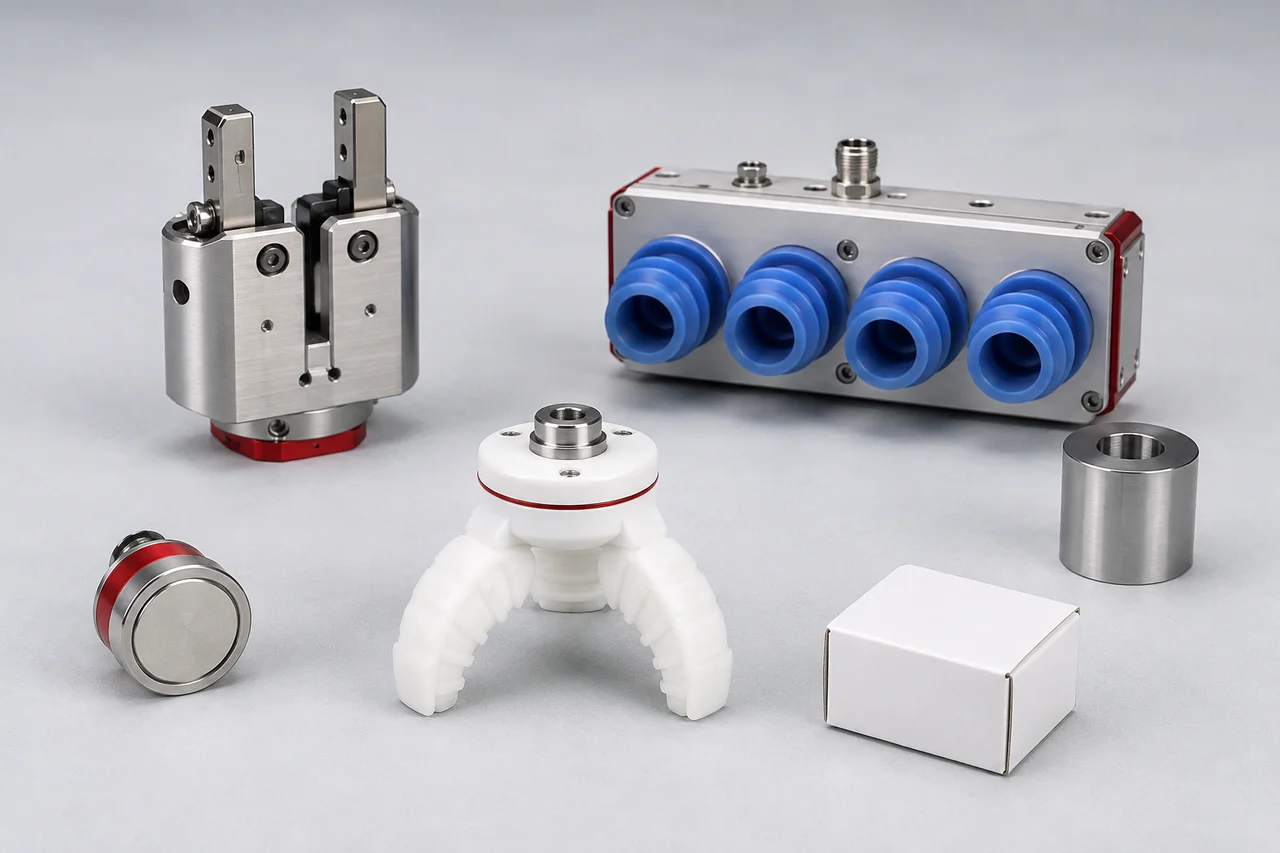
Start with a matrix of contact opportunities
Robot gripper describes several different ways of acquiring an object. A jaw may constrain its edges, a vacuum seal may act on a face, and a magnet may attract suitable material through a contact interface. Electric and pneumatic describe actuation, so they are not alternatives at the same level as vacuum or mechanical gripping. Soft fingers can also belong to a mechanical assembly.
Treat the following matrix as a shortlist aid. Its final column identifies the uncertainty that should decide the next investigation. Festo's 2020 overview describes these broad families, while Schmalz's current catalogue shows that area grippers themselves have multiple sealing and vacuum-generation arrangements. Neither source establishes a universal winner for your application.
| Principle | Promising contact opportunity | Question that can eliminate it |
|---|---|---|
| Rigid jaws | Accessible edges, shoulders or a bore | Can the fingers clear the part and receiving fixture? |
| Vacuum | A face with a usable sealing region | Can the actual surface support repeatable acquisition? |
| Soft or adaptive fingers | Variable contours with space for enveloping contact | Does deformation leave a usable placement pose? |
| Magnetic | Suitable ferromagnetic material | Do material, thickness and contact gaps support the proposed grip? |
| Custom or hybrid tool | Different useful contacts within one assembly | Does the extra mechanism solve a measured limitation? |
参考资料: Get a Handling on Grippers, 2020 white paper · Area gripping systems and end effectors, official product overview
Draw the incoming and outgoing contact maps
Begin with two drawings: the part where it arrives and the part where it must finish. Mark allowed contact faces, prohibited cosmetic areas, fragile features and locating datums. Add tray walls, neighbouring products and fixture clamps. A top surface that is unobstructed on a bench may be hidden under packaging in production. Include the space needed to open fingers, deform a soft element or withdraw a suction cup.
Ask the process owner which presentation changes are possible. A shallow tray pocket, a changed separator or a supported pickup location may create a simpler gripping opportunity. Record the cost and ownership of that change alongside the tool. The engineering question is whether the whole transfer becomes easier to control; a clever gripper is unnecessary when an affordable presentation change removes the difficult contact.
Group variation by its effect on the grip
Do not send only a nominal drawing. Separate geometric variation from surface variation and material variation. Dimensions affect jaw opening and cup coverage; oil, dust and texture affect the interface; magnetic response depends on the workpiece material. Record the extremes accepted by purchasing and quality, including supplier substitutions. A rejected incoming part should have a rejection route, not an undocumented expectation that the robot handles it.
For each proposed family, identify the variation most likely to defeat its contact. A perforation may interrupt a vacuum region while leaving a mechanical shoulder unchanged. A new coating may affect magnetic spacing even when the drawing dimensions remain acceptable. This is a reason to partition the sample set by mechanism, rather than assuming that the heaviest sample is automatically the hardest case for every tool.
参考资料: Magnetic grippers SGM, official product family documentation · Area gripping systems and end effectors, official product overview
Choose finger geometry separately from actuation
Mechanical gripping is not simply two flat pads squeezing harder. Parallel fingers, angular motion and multiple centring contacts create different access envelopes. A shaped contact may locate a part by its geometry, whereas a flat contact relies more directly on the surface interaction. Have the tooling designer explain which surfaces carry the load and which establish orientation; these functions need not be performed by the same feature.
Only then compare how the mechanism is driven. Programmable opening can reduce unnecessary travel between product variants, but it cannot make an unsuitable fingertip fit a recess. Long fingers may reach around an obstruction while increasing loading on their guides. The proposed drawing therefore belongs with the actuator selection and its manufacturer limits. The specialist electric-versus-pneumatic guide addresses that second decision once the contact arrangement is credible.
参考资料: Get a Handling on Grippers, 2020 white paper · EGU 50-PN-M-B, product ID 1491537
Follow the supported part through the whole transfer
A pickup demonstration shows one configuration. Your task may rotate the product, pass through a restricted opening or hold it while another mechanism acts. List the carried states and ask the integrator to assess how forces and moments reach the tool and robot in each. Include adapters, contact elements and attached services in the assembly definition. This guide does not convert catalogue holding force into a permitted robot payload.
Also describe the destination's contribution. A nest may establish final position after a tolerant pickup, while an unsupported placement may require the tool to preserve orientation throughout. Check whether the release sequence requires extra space, dwell or a controlled handoff. The decisive comparison is often between complete process layouts, especially when one candidate needs a reorientation station that another can avoid.
参考资料: EGU 50-PN-M-B, product ID 1491537 · Magnetic grippers SGM, official product family documentation
Worked hypothetical example: a perforated lid family
Imagine a workshop transferring steel and aluminium lids from shallow trays into a labelling nest. Both share an outer profile, but some have ventilation holes and the visible top must remain unmarked. The initial shortlist is vacuum on a clear flange, mechanical contact beneath a rolled edge, and magnetic contact on the steel variant. These are proposed concepts, not tested configurations or declared safe loads.
The magnet cannot be a common solution for both materials. Vacuum remains plausible only if every accepted lid has sufficient usable flange contact. Mechanical fingers require access beneath the edge without touching the tray. If that access is unavailable, the team can compare a revised tray against separate tools. The example shows why family coverage is a contact question: similar silhouettes alone do not establish that one tool handles all variants.
参考资料: Magnetic grippers SGM, official product family documentation · Area gripping systems and end effectors, official product overview
Ask for a trial that distinguishes the candidates
Give shortlisted suppliers the same parts, contact restrictions and final placement criteria. Ask each to document its proposed tool configuration and unresolved assumptions before demonstrating anything. Record acquisition, retention through the approved motion, visible damage, placement and release as separate outcomes. This makes a promising pickup visible without treating it as an accepted process. Include permitted variation that challenges each supplier's stated contact mechanism.
Have competent personnel design and conduct any physical trial, including abnormal conditions and recovery. For a simulation study, explicitly label contact, friction and deformation assumptions that have not been measured. Track every attempt and its reason for failure. A useful report can conclude that a concept needs a changed fixture or material study; it need not manufacture a winner from an incomplete demonstration.
参考资料: Maintenance of work equipment · Get a Handling on Grippers, 2020 white paper
Buy a defined assembly with a change boundary
Request a quotation that identifies contact parts, mounting, utilities, sensing and integration work. Match each status signal to what it observes. Schmalz, for example, describes piston-position sensing on its SGM-S variant; an internal position is a different observation from the identity or security of the workpiece. Ask what process evidence resolves any remaining uncertainty before the next action.
Keep the accepted contact drawing, sample descriptions and limitations with the purchase decision. Name changes that reopen selection: a different coating, revised tray, replacement finger material or new carried orientation. Plan inspection and replacement with the equipment supplier and responsible maintenance team. This keeps the broad family choice connected to the specific assembly that eventually earns acceptance.
参考资料: Magnetic grippers SGM, official product family documentation · Maintenance of work equipment
检查清单
- Mark permitted and prohibited contacts at pickup and placement.
- Separate gripping principle, finger geometry and actuation in the shortlist.
- List accepted dimensional, surface and material variation.
- Review carried orientations and destination support with the integrator.
- Require evidence for release and accepted placement as well as pickup.
- Compare complete tooling, presentation and service requirements.
- Retain the trial configuration and the changes that require reassessment.
常见问题
Can one robot gripper handle every part in a product family?
Sometimes, but establish common contact opportunities first. A shared outside shape does not remove differences in coating, perforations, stiffness or magnetic response. Use the difficult accepted variants to determine whether one assembly, interchangeable contact parts or separate tools are justified.
参考资料: Magnetic grippers SGM, official product family documentation · Get a Handling on Grippers, 2020 white paper
Is an electric gripper a different gripping principle from a mechanical gripper?
Electric identifies the actuator. An electrically driven jaw gripper is still mechanical, and other gripping principles can also use electrical services. Compare the contact method first, then the control, utility and failure behaviour of exact candidate assemblies.
参考资料: Get a Handling on Grippers, 2020 white paper · EGU 50-PN-M-B, product ID 1491537
来源与审核
Documentary selection guidance checked on 6 September 2026. Product families illustrate gripping principles; the lid scenario is hypothetical. Suitability, permissible loads and physical trial procedures require assessment of the exact assembly and application.
适合读者:Workshop engineers shortlisting robot tooling. 更新于 .
- Get a Handling on Grippers, 2020 white paper
- Area gripping systems and end effectors, official product overview
- Magnetic grippers SGM, official product family documentation
- EGU 50-PN-M-B, product ID 1491537
- Maintenance of work equipment