内容概要
The December 17 launch changed the entry cost and software-enabled performance of the Jetson Orin Nano developer kit. Before ordering new hardware, identify the board you already own: NVIDIA said existing Orin Nano developer-kit owners could obtain the Super improvement through a software update. For a new buyer, the important question is whether an 8 GB edge system can run the complete intended application, not whether the $249 headline sounds inexpensive.
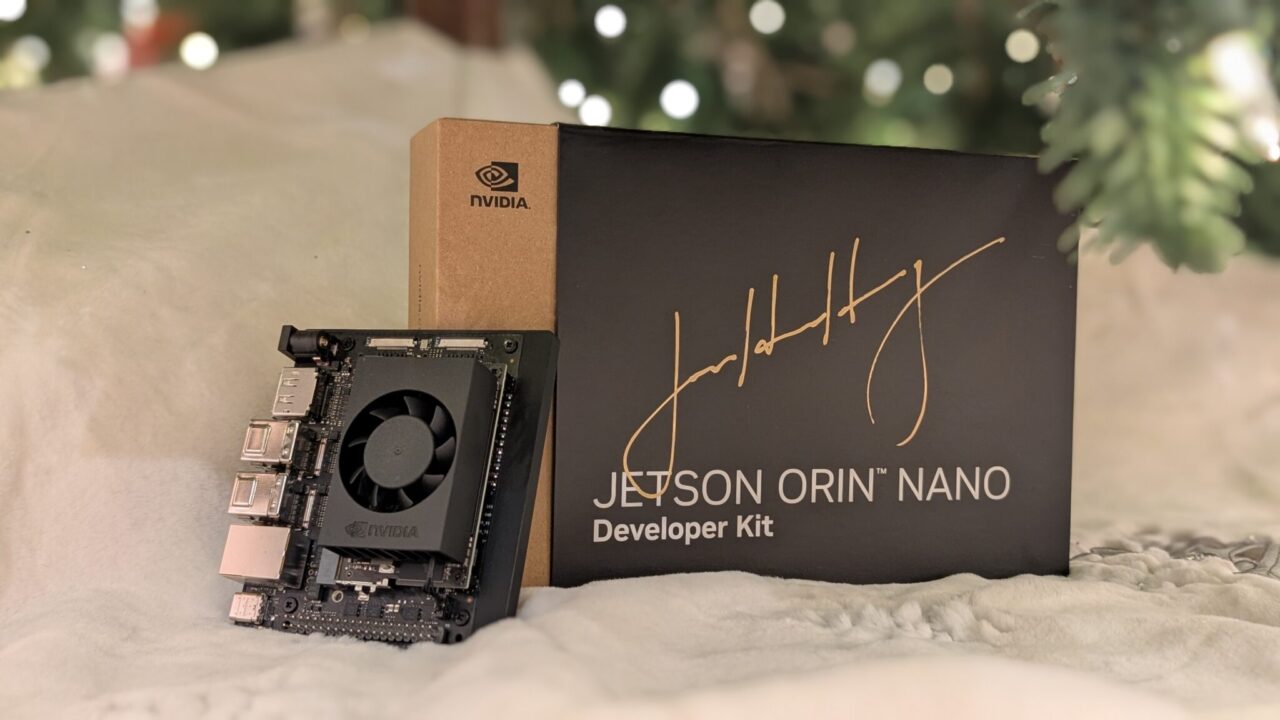
The announcement, bounded to December 17, 2024
NVIDIA announced the Jetson Orin Nano Super developer kit at US$249, down from $499, with availability that day. It reported up to 1.7 times the generative AI inference performance and 102 GB/s memory bandwidth. These are manufacturer launch claims, not measurements made by Application Robot.
This article does not retrospectively add later models, software releases or benchmark wins to that offer. It asks what a robotics learner could reasonably evaluate from the announcement itself. A launch price is also not a delivered quotation for every country: check taxes, shipping, stock and the exact seller's included items separately.
参考资料: NVIDIA Unveils Its Most Affordable Generative AI Supercomputer
Already own an Orin Nano? Identify it before replacing it
The launch was not simply a new board that made every existing kit obsolete. NVIDIA's official announcement said the improvement was available to existing Orin Nano developer kits through software. Its technical explanation described a higher-performance operating mode on the existing hardware design. That distinction can save a duplicate purchase.
Read the product label and record the module and carrier-board identity before planning an update. 'Jetson Nano' and 'Jetson Orin Nano' are not interchangeable names. A third-party carrier, a production module and NVIDIA's reference developer kit should not be assumed to share one installation procedure.
Back up a working project and record its current image and dependencies. Then follow instructions for that exact hardware and release. Compare the same recorded input before and after updating, and retain a recovery route. Do not paste a forum command into an unfamiliar system merely because both posts contain the word Super.
参考资料: NVIDIA Unveils Its Most Affordable Generative AI Supercomputer · NVIDIA Jetson Orin Nano Developer Kit Gets a Super Boost
What 67 TOPS and 8 GB tell you
NVIDIA's launch technical table specified 67 sparse INT8 TOPS and 8 GB memory. Its higher-power specification included a 25 W module mode. Those units matter: sparse INT8 throughput is not a frame-rate guarantee, and a module power mode is not the consumption of a complete robot or even every peripheral attached to the kit.
Write down the memory users in your own application: model weights, runtime allocations, image buffers, operating system, user interface and logging. Do not estimate feasibility from the downloaded model file alone. Keep headroom for the worst input and for recovery after an interrupted request. A useful trial records peak memory while the whole application runs, not just whether an isolated model can load.
Similarly, define the output that matters. For a visual inspection helper it might be a correct result attached to the right captured frame within an agreed interval. Tokens per second and peak TOPS describe other things. A fast answer associated with an old image is still the wrong operational result.
参考资料: NVIDIA Jetson Orin Nano Developer Kit Gets a Super Boost
Start with a recorded-camera inspection question
A manageable first project is an offline bench observer: given a saved image of a work area, identify whether a known fixture or component is visible. Collect examples from the actual camera position, including empty scenes, partial occlusion, glare and an unfamiliar object. Label the expected answer before running the model. Keep this separate from automatic acceptance of production parts.
Replay the same inputs through each candidate configuration. Track false positives and false negatives independently; a single average accuracy figure can hide the failure that matters most. Inspect wrong answers rather than immediately adding a larger model. The limiting issue may be lighting, framing or an ambiguous task definition rather than compute.
Only then try a live camera. Timestamp each frame and its result, define how long a result remains useful, and show when the system has no fresh answer. Initially the output should be advisory or recorded for evaluation. There is no need to connect a robot's motion interface to learn whether the vision task is viable.
The $249 kit is not the full project budget
Create a bill of materials around the task, not around the photograph. Verify what the specific kit offer includes, then account for storage, camera and lens, lighting, suitable cables, mounting and any enclosure needed for the bench. Separate reusable equipment from items consumed by each additional installation. Leave development time visible rather than treating software integration as free.
Ask two purchase questions: can the supplier identify the exact SKU, and what will it take to reproduce the setup after a failure? Keep the quotation, included-item list and support route with the project records. An apparently cheaper bundle may be a different carrier configuration, and a ready-to-run enclosure may include engineering you would otherwise do yourself.
Do not assign invented prices to the remaining parts to make a tidy total. Obtain task-specific quotes. If the experiment is only a short feasibility study, compare buying with using hardware already available to the team. The launch creates an option; it does not make that option mandatory.
Developer-kit support was not the same as every production module
The dated opening post in NVIDIA's announcement forum distinguished the developer kit from production modules. At launch, expanded performance support for production Orin Nano and Orin NX modules was planned for January 2025. That was a forward-looking statement on December 17, not evidence of an already delivered capability for every module.
For a product team, treat this distinction as a procurement gate. Write down which hardware and software pairing is available for the prototype, which pairing is required for production, and what evidence would close the gap. Avoid basing a fixed customer delivery date on a promised update without a contingency.
The linked technical article is a living web page. Its later edits and expanded model examples are not being treated here as launch-day evidence. Use the dated announcement for historical scope and verify the precise installation instructions separately when maintaining a real device.
参考资料: Introducing The Most Affordable Generative AI Supercomputer: original staff announcement
A repeatable acceptance run for a small robotics lab
Run the intended application from a cold boot and record how it becomes ready. Repeat with external networking unavailable after the required assets have been provisioned. Check that missing files, unavailable services or incomplete model downloads produce an understandable failure rather than a silent blank screen.
Next, run the camera, inference, display and logging together for a representative work session. Watch temperatures, memory use and delays as well as whether the process stays alive. If performance degrades, preserve the logs and configuration before changing several settings at once. A short successful demonstration is not evidence of sustained behaviour.
Finally, interrupt the application and restart it. Confirm that old results are not presented as current observations and that the project returns to a known state. Record the pass criteria and failed examples with the software revision. This gives the next learner something reproducible, instead of a claim that the board 'runs AI' with no explanation of the workload.
Who should evaluate it, and who should pause?
The strongest starting case is a bounded local inference experiment with modest memory needs, an identifiable hardware configuration and someone able to maintain its software. Existing Orin Nano developer-kit owners should first investigate the supported upgrade path. New buyers should confirm the complete workload fits before buying multiple units.
Pause when the actual requirement is a finished industrial vision appliance, a supported robot integration package or a workload that already exceeds the memory budget. The developer kit is a development purchase, not evidence that those wider requirements are met. A good result from this launch is a cheaper, measurable experiment with a clear next decision, not an unsupported promise of production autonomy.
检查清单
- Confirm whether the existing board is an Orin Nano developer kit, not the original Jetson Nano.
- Save the working software configuration before investigating the Super update.
- Treat US$249 as a December 2024 announcement price, not a current delivered offer.
- List the complete workload's memory requirements and test them together.
- Use repeatable recorded inputs before adding a live camera.
- Measure stale results, restart behaviour and sustained operation, not only inference speed.
- Keep production-module promises separate from developer-kit availability.
常见问题
Does Super mean every owner needs a new board?
No. NVIDIA explicitly offered a software upgrade for existing Orin Nano developer kits. Identify your exact kit before deciding, and do not generalise that statement to every product carrying the Jetson name.
参考资料: NVIDIA Unveils Its Most Affordable Generative AI Supercomputer
Can it replace a Fairino controller?
That is not what this launch establishes. Treat a local inference computer and the robot's controller as separate systems. Any connection needs a model- and software-specific integration design; this guide starts with observation rather than motion commands.
Should I choose a model solely because it fits in 8 GB?
No. It must also produce sufficiently reliable answers for the task while sharing memory with the rest of the application. Validate the complete pipeline, including difficult inputs and recovery, before calling it a fit.
来源与审核
Retrospective December 17, 2024 launch snapshot; simulation publication December 17. Sources checked September 6, 2026. Only the original staff announcement and corroborated launch facts are used; later technical-page additions and subsequent software releases are excluded. Prices are historical manufacturer announcements. The evaluation workflow is editorial analysis, with no hands-on test or delivered quotation claimed.
适合读者:Robotics learners and small teams planning a first local inference prototype. 记录更新于 .
- NVIDIA Unveils Its Most Affordable Generative AI Supercomputer
- NVIDIA Jetson Orin Nano Developer Kit Gets a Super Boost
- Introducing The Most Affordable Generative AI Supercomputer: original staff announcement