内容概要
An FQE is a candidate for a Fairino application only after the exact gripper configuration, robot interface and workpiece behaviour have been checked together. Its published UR-flange mass table is a reference configuration, not a Fairino mounted-mass declaration or proof of compatibility.
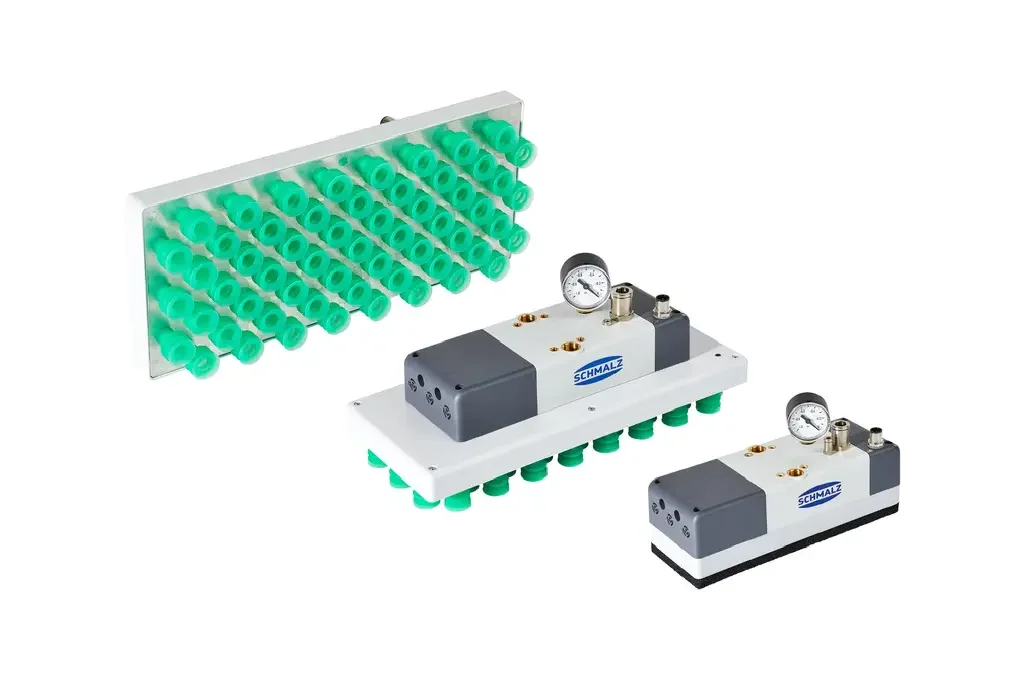
Start with an orderable assembly
Ask the supplier to identify the complete FQE ordering configuration before comparing quotations. The operating instructions cover configurations with different gripping surfaces and vacuum arrangements; the family name alone does not describe what arrives. Request the order confirmation, dimensional drawing, pneumatic schematic and electrical information for the offered unit. Put the robot model, controller version, workpiece drawings and intended transfer orientation on the same enquiry. This gives each supplier a common application to assess and makes omissions visible before they become workshop problems.
Build an inclusion list with a named owner for every missing item: robot adapter, locating hardware, cable, fittings, vacuum source, sensing, software integration and replacement contact elements. Mark each as supplied, separately quoted or awaiting confirmation. A useful quotation explains who resolves an interface mismatch and who commissions the completed assembly. Treat an attractive photograph of a gripper on another robot as a configuration clue; request documentary confirmation for the actual Fairino installation.
参考资料: FQE operating instructions, 30.30.01.02497, revision 05, September 2024
Read the mass table with its flange footnote
The FQE manual's page 19 table states that its values apply to an FQE-Xc including a flange for UR. For example, the foam configuration at 220 x 80 mm is listed at 0.95 kg. Preserve that qualification whenever using the number. It does not establish the mass of an FQE with a Fairino adapter, nor does it justify adding a second complete adapter allowance if the original flange remains inside the quoted assembly.
Request a component breakdown that shows what is retained, removed and added for Fairino mounting. Reconcile it against the final assembly drawing, then have the completed tool weighed during qualified integration. Include the supported portion of services and any sensor bracket in the assessment. Keep workpiece mass in a separate column so empty and carrying states remain understandable. If the supplier cannot separate a reference flange from its published total, record the mass as unresolved instead of silently estimating a subtraction.
参考资料: FQE operating instructions, 30.30.01.02497, revision 05, September 2024
Check the robot interface and load record
Fairino's parameter-setting documentation provides entries for end-tool mass and centre-of-mass coordinates. Those settings need to describe the installed assembly. Ask the integrator to reconcile the adapter drawing, locating features, clearance envelope and fastening specification with the exact robot documentation. Record the approved drawing revision alongside the payload record. Mechanical fit, available wrist services and controller integration are separate evidence items, even when a supplier offers them as a bundle.
Define who owns the empty-tool and loaded-tool records and how the programme selects the appropriate state. Also request the tool-centre-point definition used for positioning, since that point serves a different purpose from the centre of gravity. During design review, follow the assembly through its tightest approach and most awkward orientation. A mounting solution that looks compact in a front view can still put a connector against a fixture or leave insufficient room for service routing.
Use FXCB as a separate candidate
The supplied FXCB article sheet identifies part 10.01.43.00070 and gives a weight of 2.200 kg. It also identifies an ejector module and a normally open control valve. These are facts about that article, not substitutes for FQE specifications. Place the FXCB and FQE quotations side by side only after matching their included mounting hardware, sensing and vacuum-generation scope. Otherwise the comparison rewards whichever quotation leaves more components outside its stated mass or supply boundary.
Give each candidate the same acceptance questions: which workpiece surfaces can be reached, which items remain uncovered, what services are required, and how will a failed pickup be recognised? Ask the supplier to explain why its proposed contact layout suits the part family. A larger-looking tool may be unnecessary for a narrow product, while a smaller one may require more precise presentation. Choose the configuration with evidence against your workpieces and installation constraints, rather than assuming that either family is the natural upgrade.
参考资料: FXCB-SW150 297 3R54 SPB2 40 P VSi NO, article 10.01.43.00070
Make utilities and feedback part of the purchase
Separate the command to grip from the evidence that a usable grip has developed. For the quoted assembly, request a signal schedule covering vacuum demand, release, available feedback, fault indications and the controller's response when feedback is absent. Specify connector identities at both ends and have the integrator verify electrical compatibility. A cable that physically mates is insufficient evidence that its functions agree. Include the installed hose route in the application information sent for vacuum-system sizing.
Piab's vacuum-technology explanation distinguishes systems serving several suction points from systems with a source at each point. That distinction is useful when discussing the complete architecture, even if Schmalz supplies the final equipment. Ask where the source and measurement point will sit, what becomes inaccessible after mounting, and which components a maintainer can replace without disturbing alignment. Document the expected response to loss of services through the integrator's risk assessment; purchasing language such as ready to connect should not stand in for that design work.
参考资料: Automation by vacuum technology · FXCB-SW150 297 3R54 SPB2 40 P VSi NO, article 10.01.43.00070
Request a representative workpiece trial
Schmalz's suction-cup design guidance explicitly calls for trials with porous parts. Turn that into a sample plan rather than shipping only a pristine carton. Include ordinary production variation: alternate suppliers, printed areas, seams, acceptable dents and the lightest or least rigid packaging in scope. Label samples so the resulting observations can be connected to a material and lot. Agree beforehand what counts as cosmetic damage, unsuccessful acquisition, unstable placement and an unacceptable recovery intervention.
Hypothetical example: a workshop handles sealed retail cartons and unfinished corrugated sleeves. Both appear rectangular in the enquiry photograph, but the sleeves have open edges and less support behind the proposed contact face. Request separate trial records and keep their acceptance decisions separate. If the retail carton passes, that does not close the sleeve question. Ask for observations through pickup, transfer and release, with actual tooling and operating conditions recorded by the qualified trial team.
Make the buying decision traceable
Use a decision sheet with evidence, outstanding questions and disposition for each requirement. Suppose, hypothetically, the FQE candidate meets the carton trial but its proposed adapter still lacks a final mass statement. Record the gripping question as supported and the robot loading question as open. That is more useful than averaging them into a favourable overall score. A failed requirement affecting compatibility or load retention should remain visible regardless of how many convenient features the candidate offers.
Ask the supplier to distinguish observations from predictions in its report. Video can show a sequence, but a written configuration record makes the result reusable when a cable, contact surface or adapter changes. Require confirmation of which changes need another assessment. Fairino's load-setting functions provide a place to apply correct data; they do not verify a supplier's assumptions. Close the purchase decision when the assembly, application limits, responsibilities and remaining commissioning work are sufficiently explicit to review.
参考资料: Robot parameter setting: Set end load · Design of the Suction Cup
Buy the handover as well as the gripper
Request replacement contact elements by exact part identity, along with inspection guidance, cleaning instructions and the records needed after replacement. Put maintenance access into the layout review: a wear item that can only be changed after removing the robot adapter creates a different support burden from an accessible consumable. Ask whether the spare supplied with the tool matches the tested contact material and geometry. Keep substitutions subject to review rather than treating similar appearance as equivalence.
For handover, expect the final parts list, drawings, service diagrams, payload records, programme references and acceptance observations. Identify who can explain an intermittent pickup after the original project team leaves. The FXCB sheet, for example, separately lists accessories and spare parts, illustrating why the purchase needs an explicit boundary around both. Finish with a short application statement describing the products and conditions actually assessed. This gives future experimenters a useful starting point without suggesting that documentary selection constitutes a hands-on review or an approved complete installation.
参考资料: FXCB-SW150 297 3R54 SPB2 40 P VSi NO, article 10.01.43.00070
检查清单
- Identify the complete FQE configuration and included hardware.
- Keep the UR-flange qualification attached to reference mass data.
- Obtain the final Fairino adapter drawing and mounted-load assessment.
- Agree utility connections and grip-feedback responsibilities.
- Trial representative workpieces with a qualified integration team.
- Resolve outstanding requirements before accepting the configuration.
- Collect exact spare identities and the final handover record.
常见问题
Can I enter the FQE table mass directly into a Fairino robot?
Only if qualified verification establishes that it represents the actual installed load. The cited table includes a UR flange; a Fairino mounting arrangement must be accounted for separately and its centre of gravity confirmed.
参考资料: FQE operating instructions, 30.30.01.02497, revision 05, September 2024 · Robot parameter setting: Set end load
Does the FXCB data sheet prove that the FQE will handle my cartons?
No. The sheet describes a different, identified article. Use the proposed FQE configuration and representative cartons in the application assessment.
参考资料: FXCB-SW150 297 3R54 SPB2 40 P VSi NO, article 10.01.43.00070 · Design of the Suction Cup
来源与审核
Based on manufacturer documentation, not a hands-on FQE or Fairino compatibility test. The published FQE mass table includes a UR flange; the actual Fairino-mounted assembly requires separate assessment. Examples are hypothetical.
适合读者:Fairino buyers and integrators. 更新于 .
- FQE operating instructions, 30.30.01.02497, revision 05, September 2024
- Robot parameter setting: Set end load
- FXCB-SW150 297 3R54 SPB2 40 P VSi NO, article 10.01.43.00070
- Automation by vacuum technology
- Design of the Suction Cup