内容概要
Porous cardboard needs a vacuum system assessed for continuing leakage and real packaging variation. Use representative samples to distinguish material permeability from poor contact sealing, then validate acquisition, transfer, damage and release with the qualified integration team.
Separate leakage through the board from leakage around the seal
Piab's corrugated-cardboard paper identifies leakage through the material and at the cup's contact with the corrugated surface. This distinction makes an investigation more useful than simply describing a carton as difficult. Ask the trial team to record the exact contact location and board identity whenever performance changes. A seam, fold or locally uneven panel raises a different question from an otherwise well-seated cup on permeable stock. Preserve those observations before changing several system settings at once.
Map the proposed pickup face on a sample drawing. Mark tape, print, overlaps, edges and areas with little internal support. Note whether the same locations are present across the carton family. The editorial purpose of this map is to generate testable explanations: does the problem follow a location, a material lot or the tooling? Have a qualified team investigate under controlled conditions. Do not use hand pressure against a live robot-held carton as an informal sealing experiment.
Ask about the operating point, not only peak vacuum
Piab explains that porous materials admit continuing airflow and require sufficient flow to maintain the intended vacuum. A headline maximum vacuum value therefore leaves an important purchasing question unanswered. Ask the supplier to assess the expected leakage and available flow at the proposed working conditions, including the installed connections. Schmalz's packaging catalogue also distinguishes vacuum-generation choices for porous and airtight workpieces. Use those principles to request an application-specific system selection rather than choosing solely from the largest advertised figure.
Provide the actual service route and available supply information to the integrator. Ask what measurements will distinguish a supply limitation from a contact problem, and where those measurements will be taken. Keep acquisition time, steady transfer behaviour and release time as separate observations. A system might eventually reach the intended condition while missing the process timing requirement. Conversely, a quick initial response might conceal instability once the carton changes orientation. Request evidence for the whole sequence instead of accepting a single gauge reading.
参考资料: Automation by vacuum technology · World of Vacuum Technology: Industry Solutions for Packaging
Build the sample set around purchasing variation
Schmalz explicitly recommends suction trials for porous workpieces. Make the samples representative of what purchasing and production actually accept. Include relevant board grades, supplier lots, coatings, printed and unprinted regions, and the range of filled states in scope. Record storage and arrival condition when those are part of the process. Avoid inventing a universal conditioning procedure: the team should define a sample plan appropriate to the packaging and the intended environment, with quality staff identifying legitimate acceptance limits.
Label each sample and preserve an example of a difficult but acceptable carton for reassessment. Distinguish damaged incoming packaging from a gripping failure on acceptable stock. If trials use a substitute product inside the carton, document the substitution and have the team assess whether it represents the real support and mass distribution.
Compare contact layouts against the carton drawing
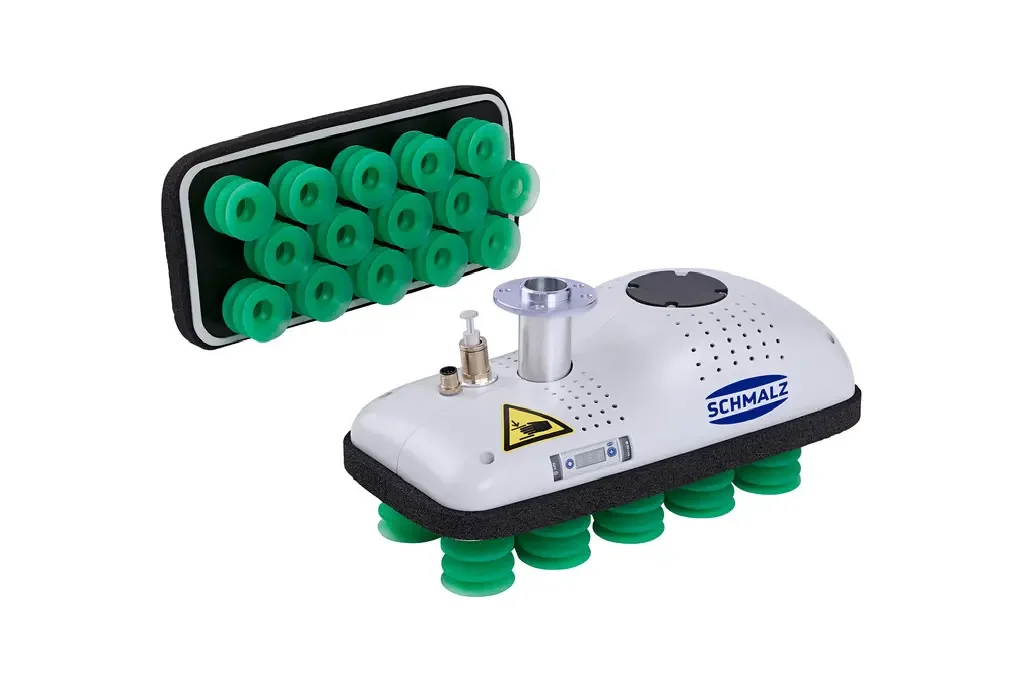
Ask suppliers to show the intended contact pattern on every carton format. A foam area tool and discrete suction cups present different layout questions: which regions are covered, where the load is supported and what happens when a seam passes through a contact location? Avoid assuming that a greater nominal contact footprint solves the problem. Ask which parts of that footprint are effective on the actual product, and require the proposed configuration to be identified in the trial report.
Piab's VGS2010 BX25P page describes a cup-and-ejector configuration intended for uneven and porous materials, with a filter disc in the cup. That makes it an example worth discussing with a supplier, not a universal prescription for cartons. Compare candidate layouts by the problems they resolve on your marked drawing. If a tool works only on a small clear patch, ask whether upstream presentation can reliably expose that patch throughout normal production variation before accepting the layout.
参考资料: VGS2010 BX25P
Inspect damage as a separate acceptance result
Piab's cardboard paper discusses the relationship between vacuum pressure and surface damage. That supports a separate quality decision alongside successful lifting. Define what inspectors will look for: visible rings, disrupted print, torn fibres, panel distortion or damage that appears during the next packaging step. Have the quality owner decide which observations fail the product. Do not use an unqualified instruction to increase vacuum whenever a pickup is unreliable; the same change can affect more than acquisition.
Agree how samples will be inspected after handling and how observations will be recorded. Photograph the same marked contact region before and after the trial when visual comparison is useful. Keep the inspection lighting and acceptance criteria consistent enough to compare candidates. Ask whether the filled carton behaves differently from an empty sample because of its internal support. If a handling method passes only with a special insert, include that insert in the application and cost decision rather than omitting it from the result.
Record acquisition, transfer and release separately
Define an observation sheet with the sample identity, tooling configuration, contact location, acquisition outcome, transfer outcome, release outcome and condition afterwards. Ask the integrator to specify suitable measurements and acceptance criteria for each stage. Schmalz's packaging catalogue discusses release arrangements alongside vacuum generation, which is a useful reminder that dropping vacuum demand and achieving a clean handoff are different process events. The receiving surface, carton orientation and subsequent tool withdrawal belong in the trial.
Hypothetical example: a carton is acquired reliably but sometimes follows the tool upward after placement. That observation does not justify choosing a higher-flow generator by itself. Ask the team to investigate the release sequence and contact behaviour using the installed configuration. In a different hypothetical result, acquisition becomes slow only on an alternate supplier's unprinted board. That directs the next investigation toward the sample's leakage and sealing characteristics. Preserve the distinction so corrective action addresses the observed stage of failure.
参考资料: World of Vacuum Technology: Industry Solutions for Packaging · Automation by vacuum technology
Include maintenance and controlled fault recovery
Ask where dust is intercepted, how the relevant components are inspected and which maintenance instructions apply to the offered configuration. Piab identifies filtration in its cited VGS example; other assemblies need their own documented arrangement. Make access part of the design review. A filter hidden behind the robot flange may create a very different maintenance task from an accessible element. Request exact spare identities and a clear method for recording replacements, so a later performance change can be connected to the installed parts.
Have the integrator define the system's response to inadequate grip evidence or loss of services, including how a retained or fallen carton is handled before restarting. Fault trials belong in a safeguarded, approved commissioning plan, with people outside the hazard area. Do not assume that a vacuum reservoir or check valve makes a porous load remain attached indefinitely. The purchase requirement should be an explained, assessed response with traceable conditions, rather than a reassuring component name or an improvised recovery habit.
Write an acceptance scope the next person can use
Close the trial with a list of carton families and conditions assessed, the exact tool configuration, observations supporting acceptance and unresolved exceptions. Keep supplier predictions distinct from demonstrated results. A short successful run should not become a claim about long-term reliability or an unsupported production failure rate. If the sample set is narrow, state that limitation and identify the missing material or operating condition. Documentary guidance can help organise the evidence, but it cannot supply absent test results.
Turn the report into a purchasing and change-review reference. Identify which substitutions require another assessment, such as a new board supplier, altered contact panel, changed cup material or revised process orientation. For a private experiment, the next step may simply be another qualified trial with a missing carton type. Avoid treating that as failure to choose a product: the useful outcome is knowing which uncertainty remains. Schmalz's trial guidance supports this evidence-first approach; the detailed record structure here is an editorial framework for applying it.
检查清单
- Map seams, print, tape and unsupported regions on each pickup face.
- Separate through-material leakage from contact-seal questions.
- Have the supplier assess flow at the intended operating conditions.
- Label representative carton lots and filled states.
- Record acquisition, transfer, release and damage independently.
- Include filtration access and exact replacement contact elements.
- Define qualified fault-recovery trials and acceptance conditions.
- State which packaging changes require reassessment.
常见问题
Will a higher maximum vacuum rating solve porous cardboard handling?
It does not answer the question by itself. Continuing leakage makes available flow at the operating condition important, and pressure can affect surface damage. The supplier needs representative samples and the complete system arrangement.
参考资料: Automation by vacuum technology · Handling corrugated cardboard: advantages through optimized pressure regulation of air-driven vacuum pumps, 18 January 2013
Can a successful trial on one carton supplier cover another?
Only if the application assessment establishes that the relevant variation is covered. Leakage and contact sealing can vary between cartons, so include accepted supplier and board variations in the sample plan.
参考资料: Handling corrugated cardboard: advantages through optimized pressure regulation of air-driven vacuum pumps, 18 January 2013 · Design of the Suction Cup
来源与审核
Documentary trial-planning guidance; no carton tests or reliability measurements were performed. Scenarios are hypothetical. The Schmalz packaging catalogue was assessed through relevant indexed excerpts, not a full-document review.
适合读者:Packaging teams and experimental integrators. 更新于 .
- Handling corrugated cardboard: advantages through optimized pressure regulation of air-driven vacuum pumps, 18 January 2013
- Automation by vacuum technology
- World of Vacuum Technology: Industry Solutions for Packaging
- Design of the Suction Cup
- VGS2010 BX25P