内容概要
Start with the surfaces the tool can reach and the way the part must arrive at its destination. Vacuum and mechanical gripping should be compared against representative parts, placement needs and recovery behaviour; neither principle wins every application.
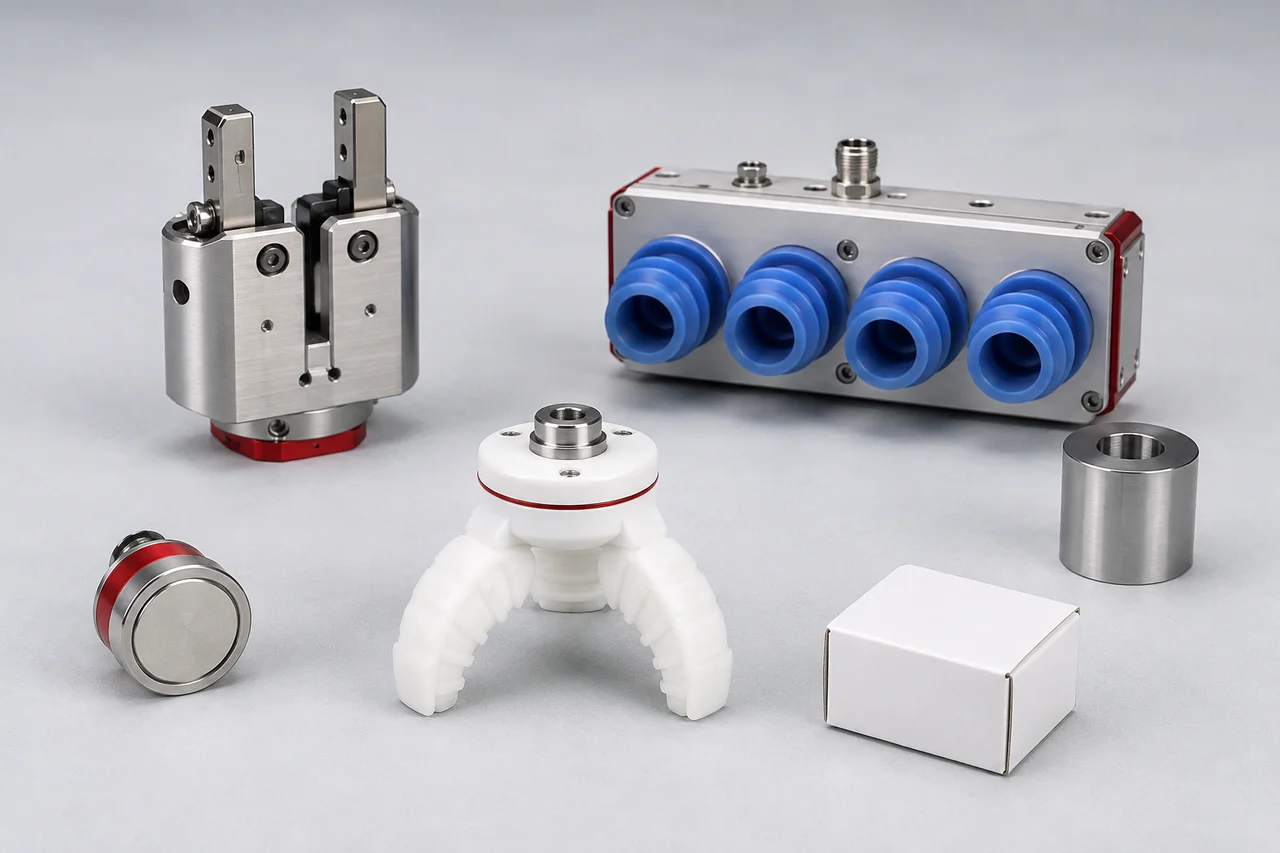
Map the available contact before comparing tools
Draw the part in its pickup container and again in the destination fixture. Mark surfaces that are accessible, surfaces that may be touched and areas reserved for inspection or assembly. A broad exposed face invites a vacuum candidate; accessible opposing faces invite a mechanical candidate. These are screening questions, not selection rules. Schmalz lists suction-cup families for different surfaces, while Robotiq describes adaptive grasp behaviour that depends on geometry and the object's position relative to its fingers.
Use the sketch to expose constraints hidden by a loose sample on a desk. Closely packed parts may block side access. A destination pocket may accept the part but leave no withdrawal path for fingers. A top surface may be covered by a label that purchasing can change later. Add those observations to the enquiry before asking suppliers for a favourite gripper. The most useful first comparison is between feasible contact plans, with tool models attached only after the contact plan makes sense.
参考资料: Vacuum Grippers · 2F-85 and 2F-140 instruction manual: General Presentation
Find the variation each principle must tolerate
Piab distinguishes porous materials, which admit continuing leakage, from sealed workpieces in its vacuum explanation. For a vacuum candidate, ask which surface conditions change sealing and which remain within the proposed system's capability. For a mechanical candidate, ask which dimensions and contact conditions change the grip. Robotiq's Hand-E specifications make clear that fingertip design and load application matter. Do not assume a supplier's demonstration with one convenient sample covers the complete range of incoming material.
Prepare a variation register organised around your process: coatings, allowable dimensional extremes, temperature on arrival, contamination from the previous operation and packaging substitutions. Mark which variations are controlled by a drawing and which depend on purchasing or handling. A gripper decision can reveal that the easier improvement is upstream, such as specifying consistent presentation or protecting a contact area. Compare the cost and practicality of that change with the complexity it removes from the tool, without assuming that upstream changes are always available.
参考资料: Automation by vacuum technology · Hand-E instruction manual: Specifications
Define acceptable contact damage
Replace the vague requirement to handle gently with an inspection decision. State whether a temporary imprint is acceptable, whether a cosmetic face can be touched, and whether a coating or delicate feature has a separate requirement. Invite suppliers to identify where their proposed tool contacts the part under normal variation. Compare that drawing with the quality criteria. A low part mass does not answer whether its surface or shape can tolerate the chosen contact method.
SCHUNK's EGP family includes adjustable-force variants and describes a special gripping mode for fragile workpieces on its IO-Link version. That is a reason to investigate controlled mechanical gripping, rather than a promise that any setting will protect a specific part. Similarly, a suction cup described for sensitive surfaces needs application evidence. Have the qualified trial team inspect parts after release and after the next process step, when a handling mark or distortion may become easier to detect.
Compare the complete handoff
Evaluate how each candidate establishes the part's final position. A successful pickup does not establish that the part will arrive at a fixture in the required orientation. Ask whether the destination provides a locating feature, whether a regrip is needed and how much variation the downstream process accepts. For adaptive fingers, Robotiq's manual describes different grasp modes depending on initial contact. Use that fact to ask the supplier how the proposed presentation keeps the grasp consistent.
Include release and tool withdrawal in the acceptance demonstration. Record whether the receiving fixture supports the part before release, whether the part remains on the tool, and whether the empty tool clears neighbouring objects. These are questions to resolve in a guarded integration trial, not invitations to reach into a running cell. If one candidate needs an extra presentation station, include its space, controls and maintenance in the comparison. A slightly more involved pickup may still produce a simpler, more repeatable handoff.
参考资料: 2F-85 and 2F-140 instruction manual: General Presentation
Decide what confirms a usable grip
Robotiq explains that its adaptive-gripper object detection infers obstruction from motion feedback rather than using tactile sensors. This illustrates a broader purchasing question: what exactly does each feedback signal establish? Ask a vacuum supplier what its monitored value represents and ask a mechanical supplier how it distinguishes a part from an obstruction. In both cases, require the integrator to explain the evidence used before transfer and the limitations of that evidence.
Write down the expected response to an absent part, an unexpected part, a failed release and loss of services. Keep the process response and the application's protective measures explicit. Test plans should include safely arranged abnormal conditions under qualified supervision, with acceptance criteria agreed beforehand. A candidate that makes failures easy to diagnose can be preferable to one that produces a reassuring status lamp but little useful information. Avoid buying extra sensors without identifying which uncertainty each additional measurement is intended to resolve.
参考资料: How Object Detection Works on Robotiq Grippers · Automation by vacuum technology
Compare ownership costs at the same boundary
Request quotations covering a usable installation: contact tooling, mounting, services, sensing, integration, documentation and commissioning. Then list recurring work such as contact-element replacement, cleaning, adjustments after product changes and recovery from failed cycles. Keep measured consumption and actual supplier quotations separate from assumptions. Do not assign an energy advantage from the words electric, pneumatic or vacuum alone. Piab's discussion of alternative vacuum architectures is a reminder that equipment configuration matters within a single gripping principle.
Estimate the labour consequences using your own production records or clearly labelled scenarios. Count recovery time only when it interrupts the relevant process, and include the time needed to confirm acceptable output after restarting. Ask whether a worn contact item is stocked locally within your organisation and who can install it under the maintenance procedure. Compare a complete year of expected work only after defining the production schedule and product mix. An unexplained catalogue price is a poor proxy for those obligations.
参考资料: Automation by vacuum technology · Hand-E instruction manual: Specifications
Worked hypothetical comparison: a moulded housing
Hypothetical example: a moulded housing arrives upright in a tray and must enter a test nest with its side connectors exposed. Its top is broad but includes a recessed logo; its sidewalls contain delicate clips. The initial vacuum candidate targets a clear top region. The mechanical candidate uses supplier-designed fingers contacting reinforced areas below the clips. Neither has passed a trial. The comparison sheet asks each supplier to demonstrate access, acceptable surface condition, orientation at placement and an unobstructed exit from the nest.
Now introduce an approved housing variant with a different top texture. The vacuum supplier must reassess that contact surface, while the mechanical supplier must confirm that its reinforced contact locations remain unchanged. The correct outcome might be a common tool, interchangeable contact parts or separate recipes. Robotiq's custom-fingertip guidance is relevant to the mechanical candidate's permitted geometry. The editorial lesson is to test the shared contact assumption explicitly, rather than calling a tool flexible because it can open widely or cover a large area.
参考资料: Custom Fingertips for Robotiq Grippers · Vacuum Grippers
Choose the candidate with the strongest application evidence
Agree the decision criteria before the demonstration: acceptable parts, successful transfer, correct final position, recoverable faults and a maintainable installation. Use the same sample set and process boundary for both candidates. Keep mandatory requirements separate from preferences. A tool that damages an accepted product variant cannot compensate by being easier to programme. Conversely, reject unnecessary sophistication when a straightforward tool meets the process requirements and the integration team can explain its operating limits.
If neither candidate passes, revisit presentation, contact locations or the process sequence before increasing force or adding more hardware. The source documents describe capabilities and constraints; they cannot choose the contact plan for your specific product. Preserve the final trial configuration and list the changes that would trigger another review. This creates a defensible buying decision and a useful record for later experiments, without pretending that a broad comparison article has established safe operating settings for a physical cell.
参考资料: Custom Fingertips for Robotiq Grippers · EGP gripper for small components
检查清单
- Map accessible and prohibited contact surfaces at pickup and placement.
- List realistic material and presentation variation.
- Define acceptable marks, deformation and final position.
- Compare grip confirmation and fault recovery.
- Quote the same complete installation boundary for both candidates.
- Use representative parts and agreed criteria in qualified trials.
- Keep the accepted configuration and its change-review triggers.
常见问题
Are mechanical grippers always unsuitable for fragile parts?
No. Controlled force and suitable contact geometry can make them candidates; SCHUNK describes EGP variants intended to adapt gripping behaviour to sensitive workpieces. Actual damage limits still need a representative application trial.
Does object detected mean the gripper knows which part it holds?
Not necessarily. Robotiq describes detection based on motion feedback, which does not by itself identify a component or establish its final pose. Define any additional process checks with the integrator.
来源与审核
Based on manufacturer documentation, not comparative hands-on testing or measured ownership costs. The housing example is hypothetical.
适合读者:First-time automation buyers. 更新于 .
- Vacuum Grippers
- 2F-85 and 2F-140 instruction manual: General Presentation
- Automation by vacuum technology
- Hand-E instruction manual: Specifications
- EGP gripper for small components
- How Object Detection Works on Robotiq Grippers
- Custom Fingertips for Robotiq Grippers