In brief
The August 25, 2025 Jetson Thor launch matters when a robot-side workload needs substantially more memory or concurrent inference capacity than its existing edge computer provides. The announced developer kit and the volume-priced T5000 module are different purchases. Evaluate the complete perception-and-reasoning pipeline, its thermal budget and its software dependencies before treating a larger compute specification as a faster or more capable robot.
What became available on August 25?
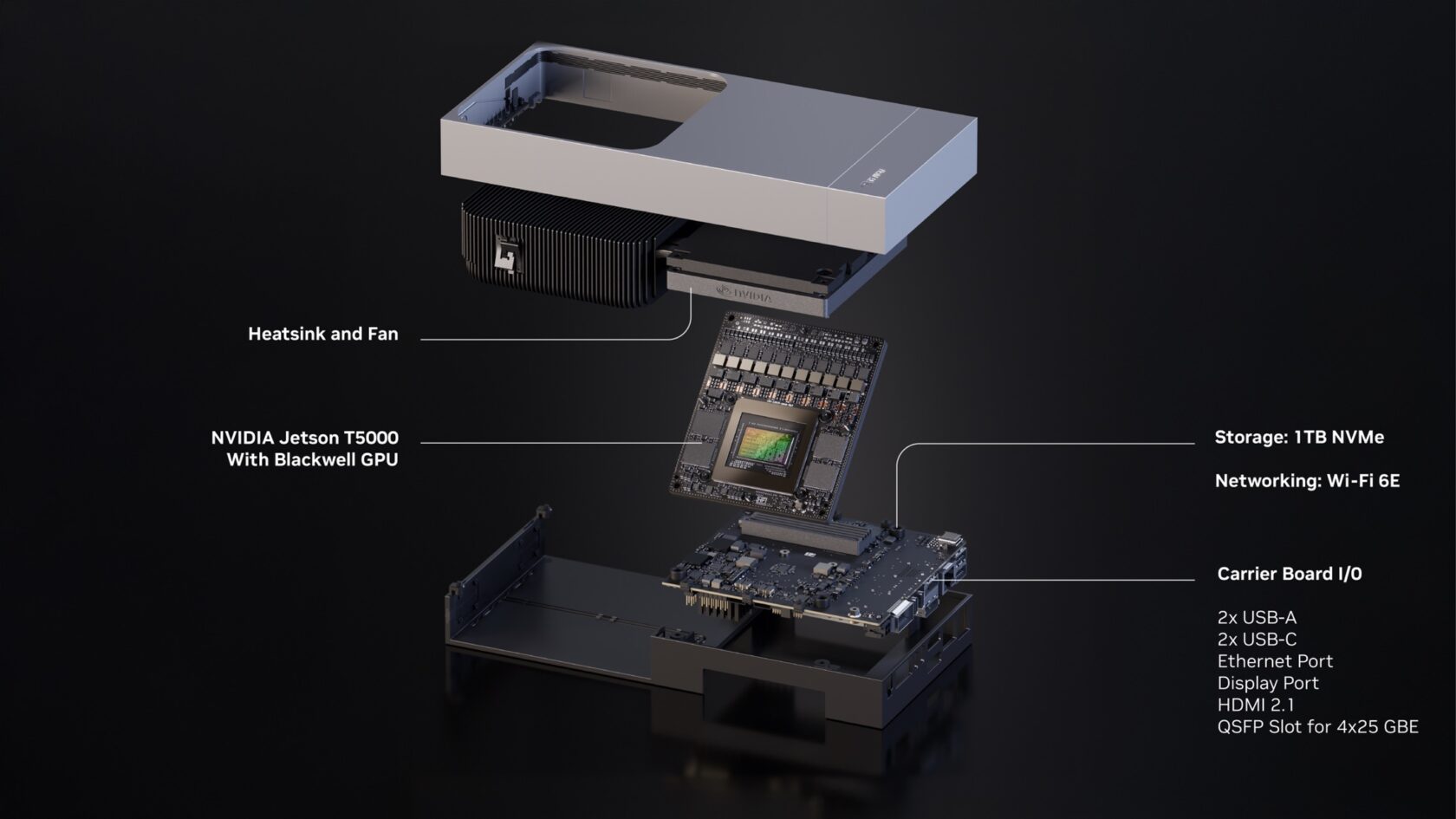
NVIDIA announced general availability of Blackwell-based Jetson Thor developer kits and production modules on August 25, 2025. The AGX Thor platform was presented with 128 GB memory and up to 2,070 FP4 teraflops. Its performance comparisons with Orin were manufacturer claims, not a guarantee that a particular robot application would accelerate by the same factor.
The specific event here is general availability, not every earlier Thor preview and not every subsequent physical-AI announcement. The launch gives a team something concrete to evaluate and quote. It does not demonstrate that an existing robot integration can be moved to the new hardware without engineering work.
References: NVIDIA Blackwell-Powered Jetson Thor Now Available, Accelerating the Age of General Robotics
The $3,499 kit and the $2,999 module are different offers
The launch blog put the developer kit's starting price at US$3,499 and the T5000 module price at US$2,999 for orders of 1,000 units. It described the kit as including a T5000 module, reference carrier board, active cooling and a power supply. Do not compare the volume-module figure directly with the single-kit price and call the difference a saving available to a one-off buyer.
Ask for a written quote identifying the SKU, quantity, included equipment, lead time and support terms. A production module also implies a carrier, cooling, power and enclosure integration decision; a development purchase does not settle those designs. Separate the one-time evaluation budget from the recurring bill of materials.
The same launch blog described DRIVE AGX Thor developer kits as a separate preorder with September deliveries planned. That is not the shipping status of the Jetson kit. Similar product names are a reason to verify the offer, not a reason to merge their availability statements.
References: NVIDIA Jetson Thor Unlocks Real-Time Reasoning for General Robotics and Physical AI
128 GB helps only when it addresses your constraint
Start with a memory inventory from the current application. List loaded models, activation and cache requirements, camera buffers, mapping data, middleware, logging and the user interface. Note which workloads must coexist and which can run at different times. The relevant question is whether a larger memory envelope removes a measured limitation, not whether the biggest available number is desirable.
Keep the precision label attached to the compute figure. FP4 teraflops cannot be compared directly with an INT8 TOPS headline as though the two represented the same model execution. A change in precision also requires task-quality evaluation. A configuration that runs faster but loses an important distinction in a scene may be unsuitable for the intended use.
Use the application's own difficult examples in that evaluation. For manipulation research, distinguish perception error, an incorrect proposed action and a downstream control failure. More memory may permit a different model or additional context, but neither fact alone proves better task completion. Preserve the input, configuration and expected outcome for each failure.
Compute belongs in the mechanical and power budgets
NVIDIA's technical launch article described the platform's high-end compute specification within a 130 W envelope. Treat that as a platform specification to investigate, not the total electrical consumption of a mobile robot. Motors, sensors, communications and conversion losses belong in separate measured budgets.
Decide where the computer could physically sit before promising an onboard installation. Reserve space for airflow, connector access, cable bend radii and service removal. For a mobile platform, measure the effect of the proposed compute assembly on runtime and thermal conditions using the intended operating workload. A desk test with unrestricted airflow is not a substitute for the proposed enclosure.
Ask the mechanical and electrical owners to review the actual assembly, not just the module dimensions. If power or cooling is already the project's limiting resource, moving selected work to a site computer may be worth comparing. That alternative introduces communication and outage questions; it is a different architecture to evaluate, not automatically a cheaper equivalent.
References: Introducing NVIDIA Jetson Thor, the Ultimate Platform for Physical AI
A useful Thor trial runs the workloads together
Choose a representative sequence that forces the intended overlap: camera ingestion continues while perception runs, a higher-level model produces a proposed interpretation, and the application records results. Capture timestamps at each boundary. This exposes queues and copying costs that an isolated inference benchmark will miss.
Measure latency distributions as well as the average. Record dropped inputs, peak memory, thermal behaviour and whether one task starves another. Define how the application detects an outdated result and what it does while waiting. The robot-side requirement may be consistent freshness rather than maximum throughput.
NVIDIA described multi-instance GPU support in the technical launch article. Resource partitioning is worth evaluating for competing workloads, but it should not be presented as proof of a safety-certified control architecture. Keep the trial's observations distinct from the guarantees required by the machine's control and protection systems.
References: Introducing NVIDIA Jetson Thor, the Ultimate Platform for Physical AI
Software compatibility is a separate acceptance gate
The launch technical material positioned JetPack 7 with SBSA and CUDA 13 alignment. That is a platform direction, not a promise that every existing camera package, inference engine or custom extension will install unchanged. Avoid turning a successful framework demo into a blanket compatibility claim for your own stack.
Build a dependency matrix before migrating. For each component, record architecture, operating-system assumptions, driver requirements, source availability and the person responsible for support. Pay particular attention to vendor camera SDKs, compiled extensions and anything distributed only as a binary. Mark an item as verified only after it has run in the intended configuration.
Keep a known-working reference installation while bringing up the new one. Replay the same stored inputs and compare outputs before adding live hardware. If a model conversion is necessary, preserve both the conversion settings and the quality checks. The practical deliverable is a reproducible application image with documented limitations, not simply a screenshot of a model loading.
References: Introducing NVIDIA Jetson Thor, the Ultimate Platform for Physical AI
Inference hardware is not a robot integration package
A robot-side model may provide an observation, a proposed plan or an action representation. Those outputs have different integration risks and should not be collapsed into a generic 'AI control' label. State exactly what the prototype is allowed to produce and what validates it before anything reaches a controller.
For a Fairino project, obtain the interface and software documentation for the specific controller being used. This launch does not establish plug-and-play FR3 or FR5 support. Begin with recorded observations or shadow-mode evaluation, in which outputs are inspected without commanding motion. Keep the existing controller and protective functions independent of experimental inference.
Do not convert a demonstration video into a reliability claim. Record the tested conditions, unsuccessful attempts and human interventions. This is especially important when the proposed benefit is greater autonomy: the computer's specification does not describe recovery behaviour when perception is wrong or the requested task is impossible.
The decision record to produce before a larger order
Summarise the bottleneck that motivated the evaluation, the configuration tested and whether that bottleneck actually improved. Include sustained end-to-end results, memory headroom, enclosure observations, dependency failures and the full quoted integration cost. Retain examples where the new system did not help; they explain what the next development task really is.
Proceed when the intended workload benefits and the team can reproduce, cool, power and maintain the configuration. Defer when the application is still limited by unreliable perception, unclear requirements or unavailable software. Buying additional compute before resolving those problems may simply make the same uncertainty more expensive.
Keep this record anchored to the August 2025 offer. Later module variants, later benchmark tables and later software improvements belong in separate dated evaluations. That makes it possible to understand why a purchase looked reasonable at the time without rewriting the decision using information that arrived afterwards.
Checklist
- Identify Jetson AGX Thor rather than assuming a similarly named DRIVE product has the same availability.
- Separate the single developer-kit price from the 1,000-unit T5000 module offer.
- Profile the existing memory and end-to-end latency bottlenecks first.
- Record compute precision alongside any performance comparison.
- Test concurrent camera, inference and logging workloads with freshness limits.
- Validate the actual enclosure, power budget and service access.
- Verify every critical software dependency on the target configuration.
- Keep experimental model outputs outside unvalidated motion and protective functions.
Common questions
Was the $2,999 price an alternative single-unit developer kit?
No. The launch blog attached that figure to T5000 modules ordered in quantities of 1,000. The developer kit was a different package starting at $3,499. Neither historical figure is a present delivered quote.
References: NVIDIA Jetson Thor Unlocks Real-Time Reasoning for General Robotics and Physical AI
Can the FP4 figure predict my robot's cycle time?
Not by itself. Camera acquisition, model quality, data movement, queues, planning and physical movement all affect the application. Measure the intended end-to-end task and retain the compute precision when comparing specifications.
Should a small fixed vision task move to Thor immediately?
Not without a demonstrated limitation in its current setup. A smaller system may already meet the task's requirements. The useful comparison is the measured workload, support burden and complete integration cost, not the prestige of the newer module.
Sources & review
Retrospective general-availability snapshot with an August 25, 2025 knowledge cutoff and August 25 simulation publication. Primary sources checked September 6, 2026. Later T4000 information and later benchmark additions to living technical pages are excluded. Manufacturer specifications and historical prices are attributed; proposed tests and purchasing criteria are editorial analysis, not hands-on results or safety certification.
Audience: Robotics developers evaluating higher-capacity onboard inference hardware. Record updated .
- NVIDIA Blackwell-Powered Jetson Thor Now Available, Accelerating the Age of General Robotics
- NVIDIA Jetson Thor Unlocks Real-Time Reasoning for General Robotics and Physical AI
- Introducing NVIDIA Jetson Thor, the Ultimate Platform for Physical AI