In brief
Fund a pilot to answer a specific production question and define the evidence that would justify stopping, revising or scaling it. Separate measured results from assumptions, count only achievable benefits, and test how the decision changes when utilisation, support needs or costs differ.
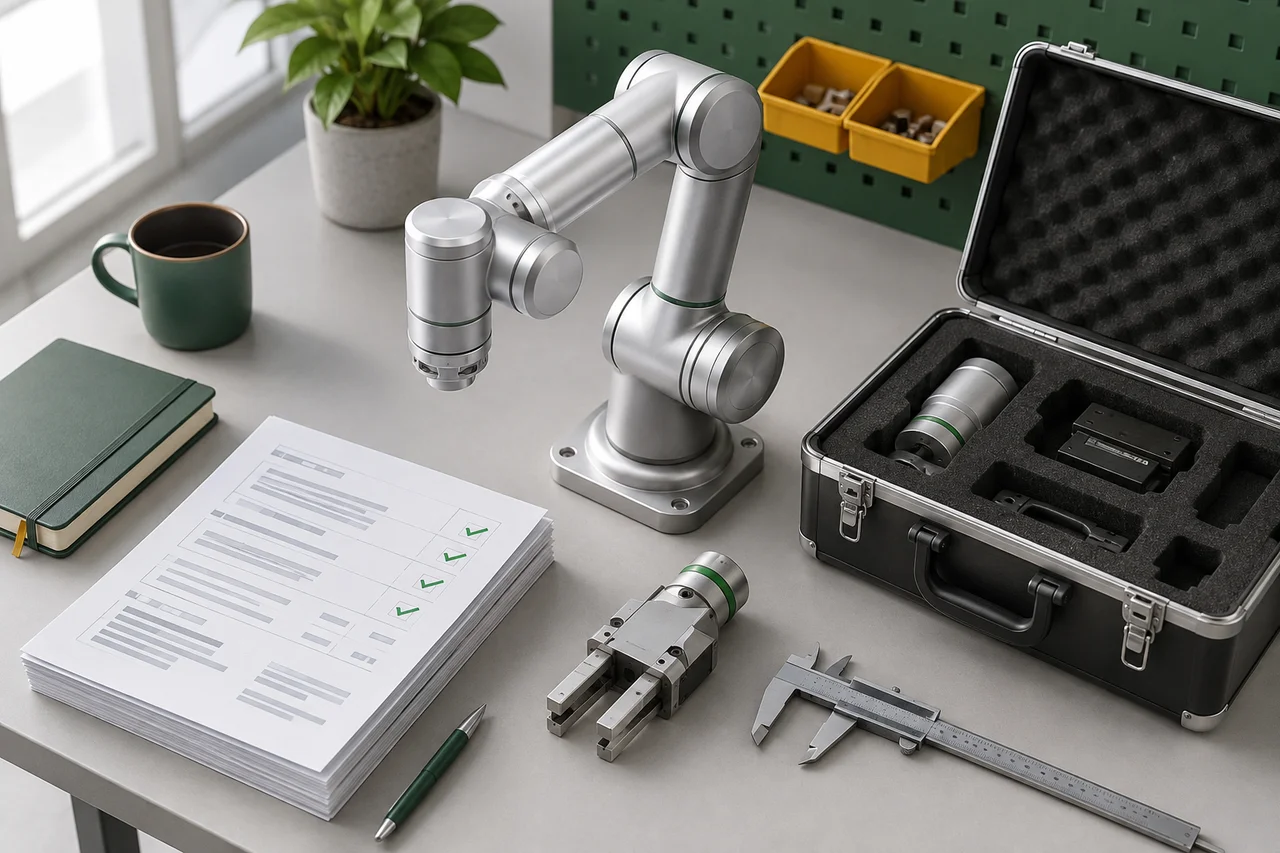
State the decision the pilot must enable
Write the proposed decision before writing a return calculation. A useful pilot question is whether a defined part family can be handled with acceptable quality and manageable operator attention under your site's conditions. Name the production problem, the process owner and the person who can authorise the next stage. Specify what the pilot excludes, such as other products or unattended operation, so a successful narrow demonstration does not become an unsupported claim about the whole factory.
NIST's capital-investment guidance includes costs, benefits and risks, including effects that are not financial. Apply that principle by listing the evidence needed for the decision: quality, labour demand, recoverability and integration readiness. Keep technical feasibility, operational usefulness and affordability as separate questions. A pilot can answer one positively while leaving another unresolved, which is valuable information when deciding whether further work is justified.
References: Capital Investment Analysis
Measure a baseline that the pilot can fairly challenge
Observe the existing process across representative work, including replenishment, changeovers, waiting and rejected outputs. Define the measurement boundary and quality method before collecting data. Record whether an operator is continuously occupied or intermittently attending the station. A short stopwatch observation of the manual movement should not be treated as the labour content of an entire shift. Ask the operators which exceptions consume attention and make those visible in the baseline.
Separate the constraint you want to improve from other limitations. If an upstream machine determines output, faster robot motion may not increase sellable production. If demand is uncertain, extra theoretical capacity is not established revenue. Keep a record of sample selection, conditions and unusual events so the later comparison is interpretable. These are original measurement questions for the project team, informed by NIST's evaluation framework rather than claimed as a prescribed NIST pilot protocol.
References: Capital Investment Analysis
Bound the pilot's scope and spending authority
Define the equipment, part family, site interfaces, people and trial conditions included in the pilot. Request a supplier scope that identifies what is reusable in a later installation and what may need redesign. Include sample preparation, fixtures, qualified integration, training, production access and project management in the pilot budget. Record the cost of ending the trial or restoring the previous arrangement where relevant, instead of assuming every unsuccessful pilot can be unwound without work.
Set a spending limit and a decision point for additional engineering. Changes that alter the application should return to the responsible technical specialists for review. Universal Robots' commissioning guidance requires relevant checks before use and after modifications; a trial label does not remove that need. Define a safe, authorised fallback production arrangement before the pilot begins. Keep the authority to stop the trial clear when required evidence or operating conditions are missing.
References: Commissioning: UR10e user manual · Capital Investment Analysis
Classify benefits by how they could be realised
Separate cash savings, released staff capacity, additional contribution from sales, quality improvements and nonfinancial outcomes. Released time becomes a cash saving only when a real cost can be avoided; otherwise it is capacity available for another useful task. Ask the relevant manager how that time would be used. Additional output needs available demand and an achievable downstream route before it supports a commercial benefit. Quality improvements need evidence from the same acceptance method used for the baseline.
Avoid counting the same improvement twice. If released labour is assumed to produce additional work elsewhere, do not also count its entire wage cost as an avoided expense without a compatible staffing change. Use contribution after relevant variable costs when estimating the value of additional sales, with assumptions reviewed by the budget owner. Keep ergonomic or learning benefits visible in their own terms; they do not need invented monetary values to matter in the decision.
References: Capital Investment Analysis
Work an illustrative sensitivity example
The following arithmetic uses invented planning inputs and arbitrary budget units, not market prices or robot performance claims. Suppose a pilot suggests 120 hours of annual recoverable capacity, and the team provisionally values each usable hour at 2 units. With 60 units of annual incremental running costs, the illustrative net benefit is 120 times 2 minus 60, or 180 units. If a later installation costs 600 units, simple payback would be about 3.3 years under those assumptions.
If only 60 hours are usable, the same calculation produces 60 units and a simple payback of 10 years. If usable hours are 30, net benefit is zero and this calculation has no finite payback. The exercise exposes dependence on usable capacity. It does not show that released time will produce cash, establish a forecast or justify purchase. Replace each assumed input with project evidence and state explicitly when an input remains uncertain.
| Illustrative usable hours | Annual net benefit in units | Simple payback at 600 units |
|---|---|---|
| 120 | 180 | About 3.3 years |
| 60 | 60 | 10 years |
| 30 | 0 | No finite payback |
References: Capital Investment Analysis
Account for timing and uncertainty beyond simple payback
Simple payback leaves out the timing and value of benefits after recovery of the initial outlay. A project with an attractive headline can still depend on a long ramp-up, uncertain demand or substantial later spending. Ask the budget owner to choose an appropriate evaluation horizon and treatment of future cash flows. Keep committed spending, estimated operating costs and possible benefits distinguishable. Do not assume an equipment resale value without supporting evidence.
NIST provides a Smart Investment Tool covering net present value, internal rate of return, payback and sensitivity analysis. Those tools can help structure a developed business case, but they cannot validate unsupported inputs. For a small pilot, start by changing the assumptions most likely to reverse the decision: usable hours, intervention burden, engineering scope and demand. Test combinations that could plausibly occur together, and explain the operating story behind each case rather than presenting a precise probability without data.
References: Smart Investment Tool
Agree measurement and decision gates before the trial
Specify how the pilot records accepted output, operator attention, replenishment, changeover effort and interruptions. Include normal variation in the planned work and record deviations from the plan. Ask the integrator and quality owner to agree the permitted test conditions and evidence. Use the same counting definitions as the baseline. A trial that excludes all difficult parts may still provide useful development evidence, but its conclusions must be limited to the conditions actually observed.
Define what would trigger a stop, a bounded revision or a scaling proposal. For example, unresolved application risks prevent progression, unacceptable output blocks performance acceptance, and uncertain support may require further due diligence. Set these gates before seeing results so enthusiasm does not silently change the success criteria. When a modification is needed, record it and let qualified personnel determine the checks required before the revised trial proceeds.
References: Commissioning: UR10e user manual
Write a decision record that preserves the learning
Conclude the pilot with the original question, observed results, remaining uncertainties and recommendation. Separate evidence from supplier estimates and management assumptions. Report what failed as clearly as what worked, including extra operator attention or engineering needed to sustain the result. A decision to stop can be a successful pilot outcome if it prevents a larger poorly understood commitment. Record reusable learning such as improved part presentation or clearer interface requirements.
For a scaling proposal, rebuild the scope and budget around the production application rather than multiplying the pilot result mechanically. Identify what changes at scale and who must verify it. Present sensitivity results alongside the preferred case, with an owner for each material assumption. The final approval should concern a defined next step and its evidence, not a promise that automation will deliver a particular return simply because a demonstration completed successfully.
References: Capital Investment Analysis · Smart Investment Tool
Checklist
- State the production question and the next decision.
- Measure a representative baseline with agreed quality definitions.
- Bound pilot scope, spending authority and fallback arrangements.
- Separate cash savings, released capacity and nonfinancial benefits.
- Test the assumptions that could reverse the decision.
- Agree technical and operational gates before collecting results.
- Report observed evidence and rebuild the budget before scaling.
Common questions
Is a short payback estimate enough to approve a robot pilot?
No. The pilot needs a defined question, credible baseline, bounded cost and authorised operating plan. Treat payback as one calculation whose usefulness depends on achievable benefits and realistic assumptions.
References: Capital Investment Analysis · Commissioning: UR10e user manual
Can released operator hours be counted as wage savings?
Only when an actual cost can be avoided under a credible staffing plan. Otherwise record released capacity and identify how it could be used, without counting the same hours again as an independent saving.
References: Capital Investment Analysis
What if the pilot works technically but the economics remain uncertain?
Record technical feasibility as established only within the tested conditions. Resolve the assumptions driving the economic uncertainty, authorise a bounded further study or stop; technical success alone does not establish a business case.
References: Smart Investment Tool
Sources & review
Documentary project-planning guidance, not a hands-on pilot, financial forecast or return guarantee. Numerical examples are hypothetical; NIST tools were reviewed as documentation and were not run.
Audience: Small manufacturing project owners. Updated .
Editorial policy · Report a correction