内容概要
A magnetic gripper needs a suitable ferromagnetic workpiece and a contact arrangement assessed for the actual transfer. Catalogue attraction or breakaway force is not an approved lifting load. Verify material, thickness, gaps, orientation, part detection and release with the supplier and competent integrator, including the state retained after service loss.
Start with a traceable material description
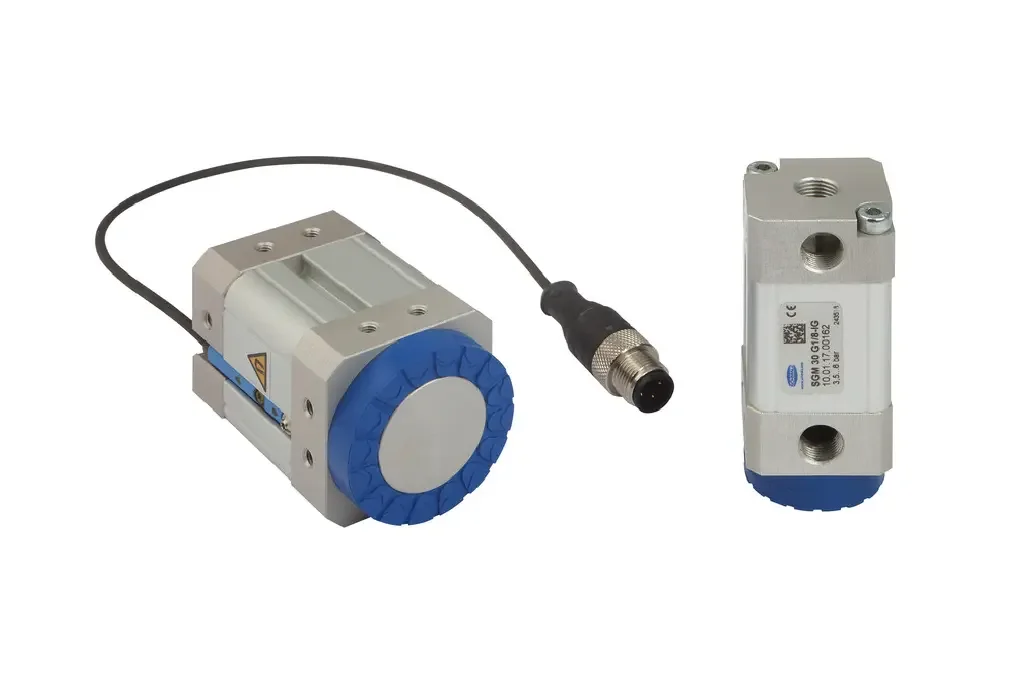
Describe the workpiece by its specified material and condition, not simply as metal or stainless. Magnetic suitability is a material question before it becomes a gripper-sizing question. Schmalz explicitly identifies ferromagnetic workpieces for its SGM family. Obtain the relevant purchasing or manufacturing record and disclose accepted substitutions to the supplier. Visual similarity and a shared part name are not sufficient evidence of equivalent behaviour.
Ask the supplier which production samples are needed to assess the proposed contact. Include relevant material lots and processing conditions rather than relying on a conveniently available offcut. If the application has mixed materials, define how unsuitable parts are identified and routed. A magnetic tool should not become an informal material classifier unless a separate, validated inspection method establishes that function.
参考资料: Magnetic grippers SGM, official product family documentation · E30 Smart Tool US Version, P/N 81401263, document 1101335 r09
Read thickness and contact conditions with the force data
Compare the force figure with its test conditions. The SGM family datasheet generated on 16 July 2026 qualifies its tabulated holding values as static figures based on a specified plate thickness and separately states its system-design factor. That footnote belongs with the number. This guide does not reproduce a universal factor or convert the table into a permitted workpiece mass.
Magswitch's E30 US-version document 1101335 r09 gives thickness and air-gap information and warns that its listed forces are not safe lifting forces. The practical implication is to send actual coating, roughness and flatness information with the workpiece drawing. Ask the responsible designer to resolve their effect for the proposed pole contact. An ideal clean, flat laboratory interface is a stated reference condition, not a description of every workshop blank.
参考资料: Magnetic grippers SGM, family datasheet generated 16 July 2026 · E30 Smart Tool US Version, P/N 81401263, document 1101335 r09
Separate the questions a workpiece trial must answer
A useful trial schedule records the magnet, contact hardware and sample identity alongside each observation. Include the smallest relevant contact region and accepted surface variation. Define acquisition, transfer, single-part handling and release separately. A test that only shows a plate attached to a stationary tool leaves the important process transitions unresolved.
Use this compact schedule to request evidence, not as an operating procedure. The supplier and integrator must design any physical testing, including load support, safeguards and the measurement method. Record which cases remain documentary assumptions in a private simulation. Changing those assumptions in a model can reveal sensitivity, but it does not measure the available holding capability.
| Workpiece or state | Evidence to request | Uncertainty addressed |
|---|---|---|
| Material and thickness variants | Supplier assessment of representative samples | Applicability of attraction data |
| Coated, rough or locally curved contact | Actual contact definition and assessed gap | Difference from laboratory conditions |
| Rotation or offset load | Review of forces and moments through the sequence | Sliding and separation demands |
| Stacked blanks | Confirmed number of parts transferred | Unwanted multiple pickup |
| Deposit and withdrawal | Final resting state and empty-tool confirmation | Incomplete release |
| Interrupted cycle | Approved retained-state and recovery assessment | Unexpected release or uncertain restart |
参考资料: E30 Smart Tool US Version, P/N 81401263, document 1101335 r09 · Magnetic grippers SGM, family datasheet generated 16 July 2026 · MG10 getting started, official product introduction
Review sliding, separation and contact hardware together
A force measured away from a surface does not directly answer whether a workpiece resists sliding along it or an offset tendency to peel away. List the orientations and process interactions in the transfer so the integrator can assess the relevant load paths. Include temporary configurations during rotation or handoff. A tool selected only from a horizontal pickup image may be missing the case that governs the design.
Schmalz identifies a replaceable friction ring in SGM and describes its role in lateral loading. Magswitch separately specifies contact hardware for E30. Keep the exact ring or pole-shoe arrangement in the proposal and acceptance record. An accessory that touches the part is part of the load-bearing design, not cosmetic packaging. Its condition and replacement identity belong in subsequent inspection planning.
参考资料: Magnetic grippers SGM, official product family documentation · E30 Smart Tool US Version, P/N 81401263, document 1101335 r09
Distinguish internal state, part presence and single-sheet pickup
Ask what each available signal measures. Schmalz describes SGM-S sensing of piston position, while OnRobot describes an MG10 proximity sensor for part detection. These observations answer different questions. Neither label alone establishes the correct material, acceptable contact or the number of blanks being carried. Write the next process decision beside the evidence intended to support it.
For destacking, request representative stacked samples and an agreed method for checking that exactly one accepted blank reaches the destination. OnRobot presents adjustable magnetic force as an MG10 capability relevant to that task, but the product introduction does not provide a validated setting for your sheets. Include variations in incoming stack condition and record any ambiguous detections. Resolve those cases before treating a successful normal pickup as proof of a dependable feeder.
参考资料: Magnetic grippers SGM, official product family documentation · MG10 getting started, official product introduction
Check release and residual effects at the next operation
Separate the tool's release command from the workpiece's observed release. Confirm the destination supports the part appropriately and inspect its final position after withdrawal. The SGM datasheet lists remaining holding force, illustrating why an off-state label should not be treated as a universal claim of zero attraction. Ask the supplier how the proposed hardware behaves with the actual part geometry and deposit fixture.
Also ask the process owner whether residual workpiece magnetism or attracted debris would affect later inspection, assembly, finishing or welding. These are application questions to assess, not an assertion that every magnetic transfer causes a defect. Where the concern matters, request an appropriate measurement and acceptance criterion from a competent specialist. Do not introduce an improvised demagnetising procedure as a substitute for identifying the downstream requirement.
参考资料: Magnetic grippers SGM, family datasheet generated 16 July 2026
Define retained state without calling the cell safe
Some magnetic designs retain their state without continuous external power. Schmalz describes SGM as bistable, and OnRobot states that MG10 maintains its grip after power loss or emergency stop. Those are manufacturer statements about named products. They do not remove the need to assess the completed tool, workpiece and cell, or establish how another magnet behaves during a partly completed switching operation.
Plan recovery around supported loads, known device state and controlled access. Competent personnel should determine how services are isolated and what energy or holding action remains. HSE's maintenance guidance is relevant to this planning but is not a magnetic-gripper commissioning manual. The acceptance package should identify the applicable manufacturer instructions and the person responsible for resolving uncertain states; an operator should not have to guess whether restoring power initiates another action.
参考资料: Magnetic grippers SGM, official product family documentation · MG10 getting started, official product introduction · Maintenance of work equipment
Worked hypothetical example: a revised laser-cut bracket
Imagine a workshop comparing magnetic handling for a perforated steel bracket. An early drawing offers a broad contact land. A later accepted revision adds a cutout near that land and changes the coating. The part is still sold under the same product family and remains light enough for the robot's nominal payload. Neither fact establishes that the original magnetic contact assessment still applies.
The review should ask whether the proposed contact hardware still meets the part as intended, whether the revised surface changes the contact gap, and whether release remains compatible with the receiving fixture. The supplier may recommend another contact arrangement or further samples. Record that as a design decision, not an automatic instruction to increase magnetic force. This hypothetical change illustrates why the workpiece revision must remain linked to the tooling acceptance record.
参考资料: E30 Smart Tool US Version, P/N 81401263, document 1101335 r09 · Magnetic grippers SGM, family datasheet generated 16 July 2026
检查清单
- Record workpiece material, thickness, coating and accepted substitutions.
- Read force data with its reference conditions and supplier qualifications.
- Assess all carried orientations and offset loads with the integrator.
- Identify the exact contact hardware and replacement parts.
- Distinguish tool state, part presence and number of blanks.
- Verify deposit, withdrawal and relevant downstream effects.
- Document retained-state behaviour and a competent-person recovery procedure.
常见问题
Can I divide catalogue magnetic force by gravity to obtain a safe payload?
No. That conversion does not assess the actual contact, dynamic and offset loads, orientation, or manufacturer design requirements. The cited E30 document explicitly distinguishes published forces from safe lifting forces. Have the application assessed for the complete operating sequence.
参考资料: E30 Smart Tool US Version, P/N 81401263, document 1101335 r09 · Magnetic grippers SGM, family datasheet generated 16 July 2026
Will every stainless-steel part work with a magnetic gripper?
Do not assume so from the generic material label. Establish the specified material and its suitability using supplier assessment of representative workpieces. Define how accepted substitutions are controlled, particularly when visually similar parts enter the same process.
参考资料: Magnetic grippers SGM, official product family documentation · E30 Smart Tool US Version, P/N 81401263, document 1101335 r09
Does a part-present signal confirm that only one sheet was picked?
Not unless the specific sensing arrangement and application validation establish that distinction. Ask what the signal observes and test representative stack conditions with an independent single-part acceptance check. Internal piston position is not a measurement of sheet count.
参考资料: MG10 getting started, official product introduction · Magnetic grippers SGM, official product family documentation
来源与审核
Documentary guidance checked on 6 September 2026. References include SGM data generated 16 July 2026, Magswitch E30 document 1101335 r09 and OnRobot's public MG10 introduction. No safe loads, physical test results or universal magnetic settings are established; the bracket example is hypothetical.
适合读者:Metalworking shops evaluating magnetic handling. 更新于 .
- Magnetic grippers SGM, official product family documentation
- Magnetic grippers SGM, family datasheet generated 16 July 2026
- E30 Smart Tool US Version, P/N 81401263, document 1101335 r09
- MG10 getting started, official product introduction
- Maintenance of work equipment