In brief
Plan CNC tending as a controlled exchange between the robot, workholding, machine and quality process. Loading a blank is only one step. The useful outcome is accepted production over a defined period, with reliable seating, chip management, machine-state confirmation and a documented response when the next cycle cannot proceed.
Choose a machining family with a stable process
Start with a repeat job whose machining program, workholding and inspection method are understood. Record blank dimensions and variation, finished-part geometry, burrs, coolant condition and the operation sequence. Identify whether the robot handles a raw blank, a partly machined component or a finished surface at each stage. A grip that is acceptable on stock may mark a finished diameter or become unavailable after material is removed.
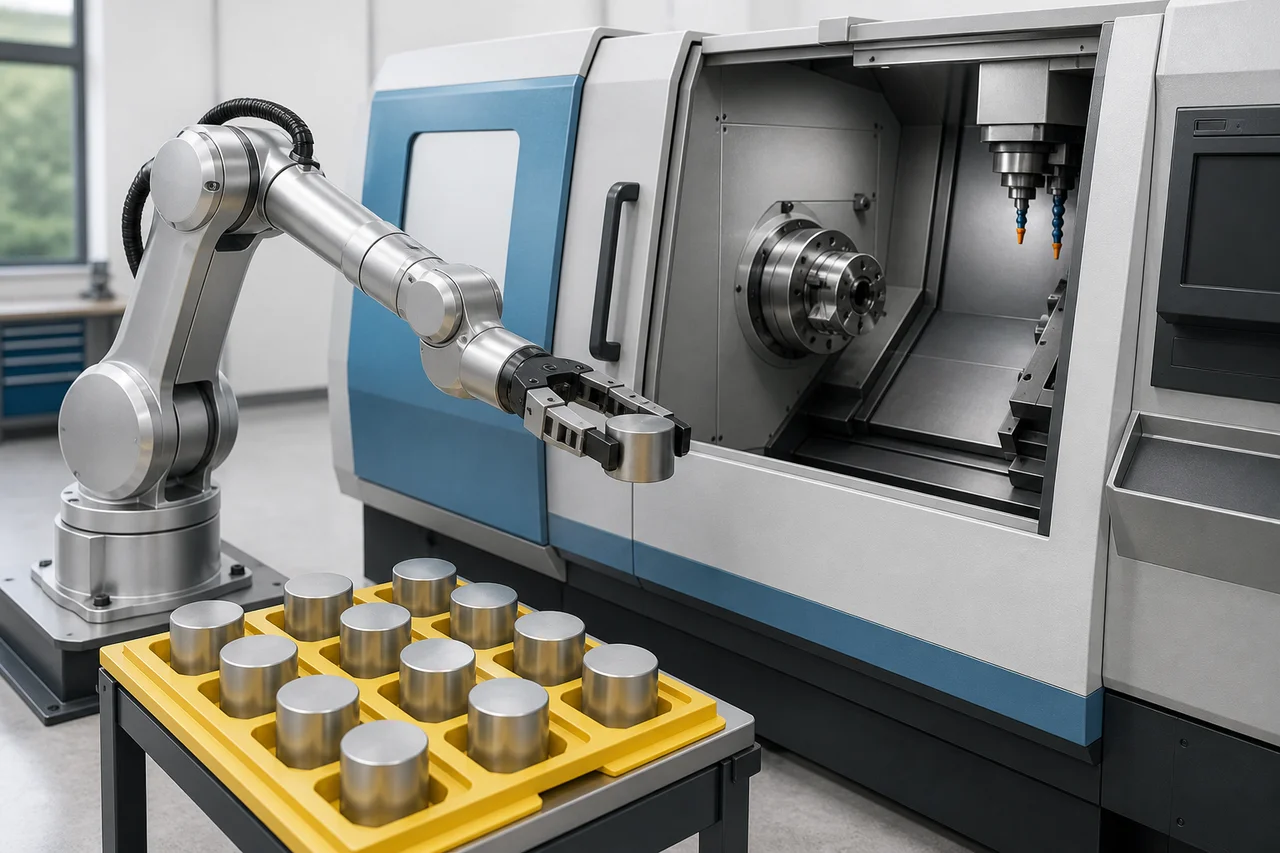
Observe a normal operator through a full batch and a return to that job. Record chip removal, jaw wiping, seating checks, offset decisions and inspection trips. These actions explain where attendance is spent and where the process still depends on judgement. Universal Robots' machine-tending overview describes a cell with the arm, mount, machine, infeed, outfeed and controller; use that as a component overview, then add the work specific to your machining process.
References: Guide to machine tending with robots, 10 March 2023
Confirm what the exact machine can support
Obtain the machine model, serial identity, controller version and installed automation options before asking an integrator to quote. Have the machine builder or authorised specialist confirm the intended door, workholding and automation interfaces. A similar machine in a supplier video may have different options or control behaviour. Request a responsibility boundary explaining who approves modifications and who supports the combined machine and robot when a fault crosses that boundary.
Haas' automation overview illustrates several alternatives, including bar feeders, pallet pools, automatic parts loaders and robot packages. Compare these against the job rather than assuming an arm is the required answer. For a compatible repeated turned-part process, a different loading method may merit a trial. The manufacturer's descriptions are examples of offered approaches, not a compatibility statement for your machine or a promise about installed cost.
References: How to Automate?
Design blank and finished-part flow together
Choose how blanks are presented and how their identity is preserved. Trays need defined pockets, orientation and replenishment rules; stacks may require separation and detection of double pickups. Give finished parts a destination that protects machined surfaces and supports the next inspection or operation. Provide somewhere to hold uncertain parts without mixing them with accepted production. The robot should not have to guess whether an occupied pocket contains a blank or a finished component.
Review the complete carried assembly for every stage. Dual grippers can be useful for exchanging a finished part and a blank during one visit, an arrangement described by Haas. They also change tool size, mass, access and contamination paths. Ask the integrator to show the actual doorway and workholding approach with both loaded states. Count tray handling and any secondary flipping fixture in the process and quotation.
References: How to Automate?
Prove seating with real chips and coolant
Assign workholding suitability and seating verification to the responsible machining and integration specialists. A commanded clamp action is not evidence that the correct blank is seated on clean locating surfaces. Specify what can be confirmed by the chosen equipment and what remains a process assumption. Include realistic blank tolerances, coolant carryover and chip conditions in the trial instead of accepting an empty-machine demonstration as proof of readiness.
Choose a chip-management method approved for the machine and assessed for the cell. Do not improvise an air-blast arrangement or place a person inside the machine to reproduce a fault. Review where displaced chips and coolant go, which sensors can be obscured and how cleaning equipment is maintained. Separate an ordinary recoverable dirty-seat condition from a situation requiring isolation and specialist intervention. This distinction determines how much unattended production the process can reasonably support.
Define an exchange with observable conditions
Write the sequence as states with evidence and responsibility, then let the competent controls team implement the machine-specific interface. The table is a process contract, not a wiring design or a safe motion instruction. Distinguish a request from acknowledgement and physical completion. Define timeout and restart behaviour so a stale completion signal from the previous part cannot authorise the next exchange.
Review normal program messages separately from protective functions. Door access, hazardous machine motion and robot operation need the validated arrangements determined by the integration team. Universal Robots' PolyScope 5.19 risk documentation places responsibility on the application integrator and includes connected machinery. Never obtain an interface by bypassing the machine's interlocks. If the builder cannot confirm a supported integration path, that is a feasibility issue to resolve before equipment purchase.
| Process stage | Evidence to define | Unresolved-condition response |
|---|---|---|
| Machine ready for exchange | Machine-specific permitted state | Wait or request authorised diagnosis |
| Finished part removed | Agreed grip and destination evidence | Hold uncertain part outside accepted flow |
| New blank seated | Workholding and seating confirmation | Use approved recovery route |
| Machining requested | Fresh machine acknowledgement | Time out without repeated blind requests |
References: UR5e Risk Assessment, PolyScope 5.19 manual
Calculate the shortest limiting unattended window
Consider a hypothetical job with a six-minute complete machine-and-exchange cycle and a tray of 20 blanks. Blank supply alone suggests 120 minutes of operation. Suppose the process requires an operator quality decision every tenth part. The initial unattended window is then at most 60 minutes, even before considering chip capacity, tool life, coolant or outfeed space. These are fictional planning inputs, not an unattended-running recommendation.
Create a separate limit for each dependency, with its evidence and owner. The minimum confirmed limit bounds the proposed window. Increasing tray capacity to 40 blanks does not remove the inspection constraint. If the quality team approves another inspection strategy, rerun the model and validate the revised process. Record time until intervention and accepted parts produced; neither spindle utilisation alone nor a long queue of blanks establishes useful unattended production.
Make quality and restart decisions explicit
Define the disposition of a part when the machine alarms midway through cutting, when grip confirmation is lost or when inspection finds a suspect result. Specify which part identities and machine events are retained for diagnosis. A recovered robot program does not establish whether the component should be recut, inspected or scrapped. Keep that decision with the authorised machining and quality personnel, supported by a clear record of what occurred.
Have the supplier demonstrate approved recovery scenarios under the integration team's commissioning arrangements. Include a controlled stop between unload and load, because that state differs from a stop during machining. Check that restarting does not double-load the workholding or send a suspect part to accepted outfeed. Operators need a readable status and a defined escalation path; a generic reset button is not a complete recovery method.
Accept a normal production window and the next changeover
Agree a test spanning realistic chip accumulation, replenishment, inspections and a return to the same part family after changeover. Count accepted components, interventions, machine waits, robot waits and rejected outcomes. Retain the controller versions, machining program, robot program, jaws, gripper and tray revisions. Report any manual action the demonstrator performed, including adjustments made between timed runs.
Use the result to decide where investment belongs. If the machine consistently waits for difficult chip clearance, faster robot motion may have little value. If changeovers consume the benefit on short batches, improve setup reuse or select a more stable family. Hand over the approved operating boundary, cleaning responsibilities, replacement tooling information and recovery package. The purchase should deliver a supported machining workflow that the shop can sustain after the supplier leaves.
Checklist
- Select a stable machining family and inspect every carried part state.
- Confirm machine identity, controller version and supported automation options.
- Define blank presentation, finished outfeed and uncertain-part storage.
- Review gripper access with loaded tooling at the actual workholding.
- Validate seating and chip control under representative conditions.
- Document machine exchange states, acknowledgements and restart behaviour.
- Calculate unattended time from its shortest confirmed dependency.
- Accept quality, recovery and changeover alongside production rate.
Common questions
Can one robot tend two CNC machines?
Potentially, but first model when each machine needs service and what happens when their demands coincide. Include travel, door access, loaded-tool states and fault isolation. A second machine can create queues or prevent access even when the robot appears idle during much of each cutting cycle.
Is unattended tending the same as lights-out machining?
No. A demonstrated period without loading attendance does not prove that tool wear, chip accumulation, coolant, inspection and other process dependencies support a whole unattended shift. Define the proposed window and obtain approval for all its limiting conditions.
Sources & review
Documentary workflow guidance checked on 6 September 2026; no machining trials were performed. Haas examples require machine-specific compatibility checks. Interface design, protective measures and process release belong to competent personnel.
Audience: Small machine shops planning CNC loading automation. Updated .
- Guide to machine tending with robots, 10 March 2023
- How to Automate?
- UR5e Risk Assessment, PolyScope 5.19 manual