In brief
A mixed-carton cobot palletiser must match each arriving carton to an approved placement, handle the complete carried load and reach every required stack pose. Assess the pallet pattern, carton condition, identification, buffering and recovery together. A successful single-carton demonstration does not prove a mixed production sequence.
Define what mixed means on your line
Separate three jobs that are often described as mixed palletising: changing between uniform product batches, building a predetermined mixed pallet from a controlled sequence, and accepting cartons in an unpredictable order. They require different scheduling and buffering. Write down which one you need, including whether cartons may wait, be diverted or go to a second pallet. State who decides the composition of a completed customer load.
Build a carton register using actual production samples. Include external dimensions, filled mass, packaging revision, closure, label location and any restrictions on orientation or support. Record combinations that are permitted and prohibited. If a supplier promises arbitrary mixed loads, ask for the supported ordering rules and the circumstances in which the software refuses a placement. A visible refusal with a controlled destination can be preferable to an unstable or untraceable load.
Establish carton identity before committing a placement
Choose an identification method that fits the source of truth. A selected recipe may be adequate for a controlled batch, while interleaved products may require a verified code or upstream transaction. Define what happens when a label is unreadable, duplicated or inconsistent with the measured carton. Keep carton identity attached to its physical position through the conveyor and any accumulation zone; reading the correct label on the wrong box defeats the purpose.
Use an exception route with sufficient capacity and a clear operator decision. Do not let an unknown carton inherit the last valid recipe. Record whether the cell can hold a carton while identity is resolved, or must divert it before picking. During acceptance, include ordinary replenishment and sequence changes so the supplier demonstrates how tracking survives conveyor stops and restarts rather than only showing a continuous ideal stream.
Check the heaviest load and the least reliable surface
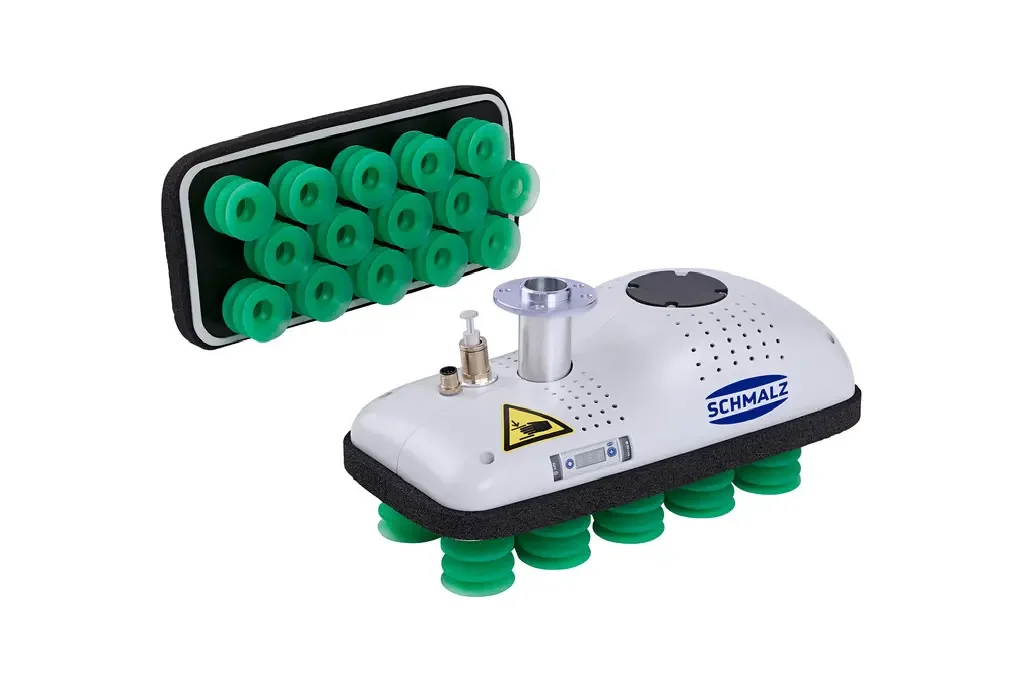
The heaviest carton and the hardest carton to grip may be different products. A large light carton may have a flexible lid or inconvenient tape seam, while a compact heavy box may offer a better contact surface. Assess each candidate gripper against filled samples and expected packaging variation. Include damage inspection after release, since a successful transfer can still crush a saleable pack.
Universal Robots' UR10e PolyScope 5.21 payload guidance includes tooling and workpiece mass and addresses centre-of-gravity effects. Request the equivalent assessment for the exact proposed robot, tool and carried states. If a tool picks more than one carton, have that arrangement reviewed explicitly, including unequal carton positions. An arithmetic mass total alone does not establish permissible acceleration, retention behaviour or suitability during a loss of services.
References: UR10e Maximum Payload, PolyScope 5.21 manual
Prove the stack envelope from bottom corner to top layer
Review the lowest and most distant placement, the highest placement, the approach above existing cartons and the return to the conveyor. Include tool height, carton orientation, cables and the growing stack in the model. A pallet corner inside a reach circle does not prove that the tool can approach it in the required orientation without the arm contacting the load. Check both pallet stations where a dual-station design is proposed.
Universal Robots' palletising deployment guide provides a UR10e example that connects mounting height, horizontal reach and stack height. Treat its diagrams as an explanation of interacting geometry, not a sizing formula for another model. Ask the integrator to document feasible poses using the quoted configuration. If a lift axis is proposed, include its control, load assessment, protective measures and maintenance in the system scope.
References: Palletizing Deployment Guide, UR10e example
Approve the pattern as a packaging decision
Have the packaging owner review support under each carton, permitted overhang, orientation and the order in which weight is added. A pattern that fits in software may leave a vulnerable carton bridging a gap or bearing an unsuitable load. Include actual pallet condition and dimensions, slip sheets if required, and downstream wrapping or restraint. Do not infer transport stability from a stack that stands still inside the cell.
The table is a compact review record for a hypothetical mixed family. It intentionally specifies evidence rather than universal stacking limits. Ask the responsible packaging and logistics specialists to define the checks that represent storage, handling and transport for the real product. Retain rejected patterns with the reason for rejection so a future recipe edit cannot reintroduce the same problem.
| Pattern case | Evidence needed | Owner |
|---|---|---|
| Heavy and crush-sensitive cartons | Approved support and loading sequence | Packaging specialist |
| Mixed carton heights | Reviewed layer transitions and clearances | Packaging owner and integrator |
| Partial customer pallet | Completion and restraint decision | Dispatch team |
| Different pallet supply | Dimensions, condition and locating review | Receiving and integration teams |
Size buffering around a realistic pallet change
Suppose a fictional line supplies six cartons per minute and an authorised pallet change takes two minutes while the palletiser cannot accept another carton. Twelve cartons arrive during that interval. If the available upstream accumulation holds only eight, the arrangement needs an agreed upstream pause, more buffering or another handling route. This arithmetic describes a hypothetical flow problem; it does not specify a safe conveyor capacity or pallet-change procedure.
After the change, the cell must also clear the backlog. If its demonstrated effective output is exactly six cartons per minute, the queue will not shrink while arrivals continue at that rate. Evaluate the busiest credible product sequence and include identification delays, slipsheet work and ordinary stops. Record the maximum queue and the way it returns to normal. An average hourly rate can conceal repeated periods of blocked upstream production.
Make a partial pallet recoverable
Define the recorded state of a load: pallet identity, accepted recipe revision, cartons placed, current layer and exceptions awaiting resolution. Then specify how that record is reconciled with the physical pallet after a stop. A controller counter can become wrong if somebody removes a carton during an authorised intervention. Recovery should require the agreed verification rather than blindly proceeding to the next calculated position.
The integration team should assess pallet exchange, access to a dropped carton, setup and maintenance as well as ordinary motion. Universal Robots' application risk documentation includes falling objects and interaction with other equipment among the issues to consider. Use qualified personnel to design any recovery demonstrations. No one should enter a hazardous area to manufacture a test fault or rely on an ordinary carton-detection signal as protective evidence.
References: UR5e Risk Assessment, PolyScope 5.19 manual
Accept a production sequence, not one finished pallet
Construct the acceptance sequence from expected orders and include the transitions that challenge the design. For example, test the smallest valid carton after the largest, an approved partial load, a pallet exchange and a recoverable identification exception. Agree the sample selection, run duration and limits on interventions before testing. Report accepted cartons, finished loads, damaged packaging, blocked time and unresolved cartons separately.
Record the robot, tool, software and pattern revisions with the results. Confirm who can approve a new carton type and what evidence is needed before its recipe enters production. The handover should include a readable explanation of rejected placements, permitted recovery choices and outstanding limitations. A bounded system with reliable rules may be the right small-manufacturer purchase even when it cannot handle every possible combination.
Checklist
- Classify batch changes, ordered mixed loads or unpredictable arrivals.
- Maintain a carton register with filled samples and packaging revisions.
- Define unreadable-label and tracking exceptions before purchase.
- Assess complete tool loads and difficult contact surfaces.
- Verify bottom, top and intermediate paths with the growing stack.
- Obtain packaging approval for patterns and partial loads.
- Test buffering, pallet exchange and physical-state reconciliation.
Common questions
Can any palletising program create stable mixed loads?
No. Coordinate generation establishes where cartons are intended to go; stability also depends on carton strength, support, contents, pallet condition and subsequent handling. Obtain packaging approval and representative validation for the permitted combinations.
Does a heavier-payload arm solve every reach problem?
No. Payload and reachable tool poses are separate selection questions. Mounting height, tool geometry, the growing stack and any lift axis must be reviewed together on the exact configuration, including the full path between pickup and placement.
References: Palletizing Deployment Guide, UR10e example · UR10e Maximum Payload, PolyScope 5.21 manual
Sources & review
Documentary planning guidance checked on 6 September 2026. The UR10e deployment example is model-specific and does not establish limits for another cell. No stack stability, gripping or throughput tests were performed.
Audience: Small manufacturers handling mixed carton families. Updated .
- Palletizing Deployment Guide, UR10e example
- UR10e Maximum Payload, PolyScope 5.21 manual
- UR5e Risk Assessment, PolyScope 5.19 manual