In brief
Buy a tool-changing system that covers the robot-side coupling, every tool-side assembly, required utilities, storage and verified exchange sequence. Payload is an initial filter; moments, locking conditions, docking geometry and fault recovery determine whether a candidate fits the application.
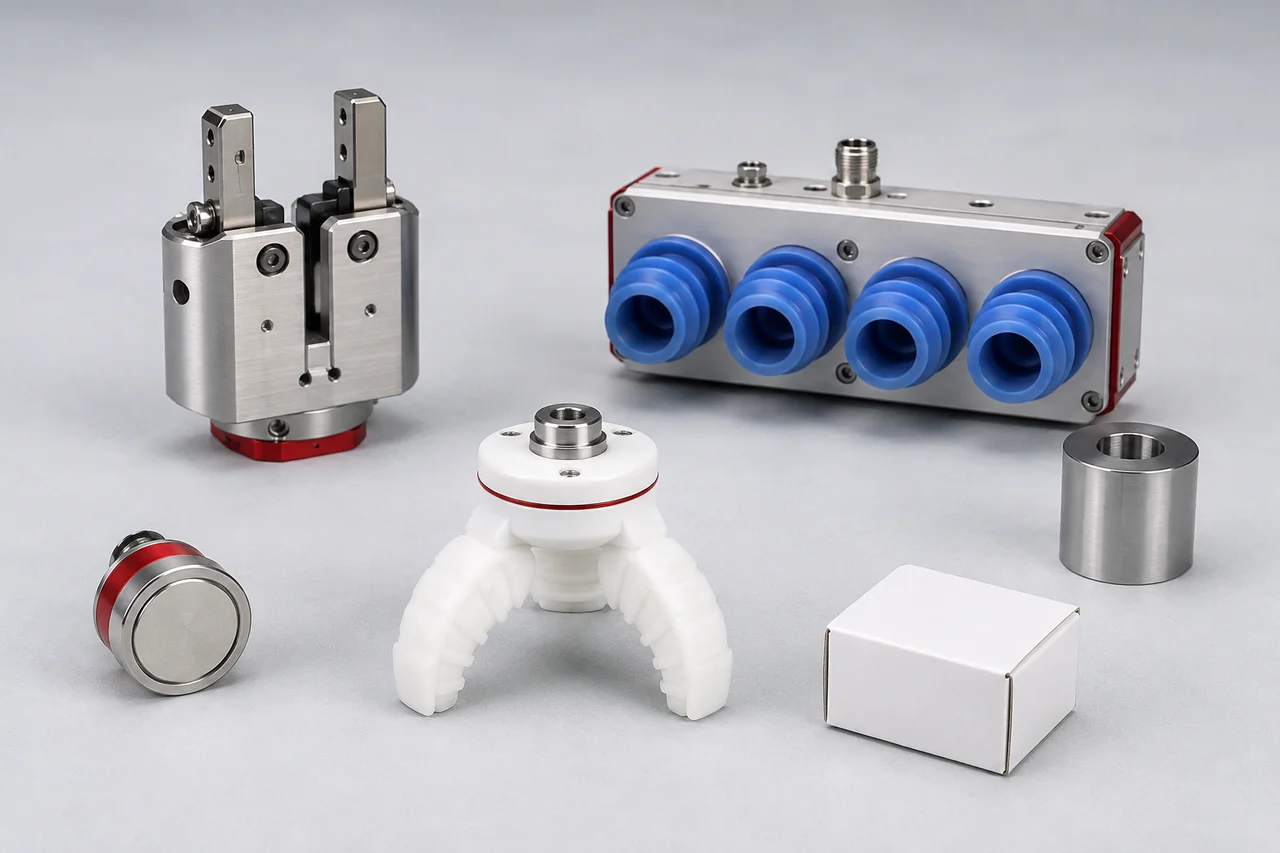
Choose the exchange method from the workflow
Start by describing when tools change and who is available to perform the change. A workshop switching between experiments after shutdown has different needs from a process exchanging tools within each automatic cycle. ATI's selection page distinguishes automatic changers, manual changers and utility couplers. Use that distinction to compare complete workflows. Record whether a mechanical exchange, reconnection of services, tool identification or renewed setup consumes the changeover effort. The largest benefit may come from making the full procedure more consistent.
Ask for a quotation against the intended workflow, including the activities that remain manual. Avoid assuming that a quick mechanical connection eliminates programme selection or setup checks. For a private forum demonstration, frequent changes might still be supervised and planned. For unattended operation, storage, sensing and recovery become central requirements. Write the scope before selecting a coupling so the project does not acquire automatic hardware while leaving the rest of the exchange dependent on undocumented human judgement.
References: Robotic Tool Changer Selection
Assess the awkward tool as well as the heaviest
ATI states that moment capacity is critical to tool-changer selection and calls for the end effector's centre of gravity. Provide each intended tool assembly, its supported workpiece states and its geometry to the supplier. The heaviest tool is not automatically the only governing case; a lighter assembly with a more distant load deserves its own assessment. Ask the supplier to identify the limiting case and the evidence used, including the intended movements and applicable dynamic considerations.
Keep robot loading and coupling loading as separate review items. The robot carries the relevant changer hardware as well as the tool, and the combined arrangement changes its load record. Universal Robots documents payload mass, centre of gravity and inertia settings; the exact robot in your project needs its own supported procedure. Include mounting adapters and service modules in the drawing sent for assessment. A bare-coupling catalogue mass cannot describe an assembled tool-changing installation.
References: Robotic Tool Changer Selection · Payload, PolyScope 5.22
Specify utilities from the controller to each tool
ATI's module catalogue separates electrical, pneumatic and fluid, control, high-current and other utility modules. Treat those as interfaces to specify individually. List each tool's required supply and signals, then ask which exact paired modules carry them. Require ratings, pin assignments, compatible connectors and the behaviour during disconnection. Where a tool needs data communication, have the integrator verify the complete communication path instead of equating connector shape with protocol compatibility.
Make the quotation show both sides of each connection and all necessary cables, fittings and protective accessories. Ask which module positions are available after mounting the tool hook or other hardware. Record the service arrangement while the tool is stored as well as while it is attached. A proposed future tool can also be included as a clearly labelled expansion requirement, but avoid purchasing unneeded modules without confirming how they affect mass, clearance and maintenance access.
References: ATI Tool Changer Modules · QC-7 tool changer: product, modules and tool-stand options
Define locking evidence and loss-of-service behaviour
The QC-7 documentation describes lock and unlock sensing and a fail-safe mechanism. Its manual also says the tool must not be operated in the fail-safe condition and that positional accuracy is not maintained in that condition. Preserve that qualification when comparing product descriptions. Retaining a tool following loss of lock air is different from confirming a normal, usable locked state. Do not interpret a retention feature as approval to continue the robot programme after a service fault.
Ask the integrator for an explained state sequence covering approach, coupling, verified lock, tool operation and return. Specify what happens if feedback is missing or contradictory and which conditions prevent motion or release. Require a controlled commissioning demonstration of the agreed responses. A purchasing checklist cannot define the required protective architecture for the complete cell, but it can ensure that the proposal includes that work and identifies who will validate it.
References: QC-7 Series Base Tool Changer with Proximity Sensors, manual revision 06 · QC-7 tool changer: product, modules and tool-stand options
Review storage as a working part of the system
ATI's QC-7 manual warns that poorly designed tool stands can cause jamming and wear. Review the proposed station with each complete stored tool, including attached modules and services. Ask whether its support arrangement matches the offered tool-side hardware and the supplier's load limits. A station holding an empty coupling in a demonstration is not evidence for a long production tool. Request a layout showing approach clearance, stored-tool envelopes and access for maintenance.
Use a design review to walk through returning a tool when neighbouring stations are occupied. Check where services rest and how the intended tool is identified before pickup. Discuss contamination from nearby processes and the applicable protection or cleaning provisions. If a station must be moved to access another machine, identify how its location is restored and checked. Include station installation and commissioning in the quotation, so storage is not reduced to a bracket that someone is expected to improvise later.
References: QC-7 Series Base Tool Changer with Proximity Sensors, manual revision 06 · QC-7 tool changer: product, modules and tool-stand options
Compare quotations at the same assembly boundary
Hypothetical example: a workshop wants to exchange a vacuum tool and a mechanical gripper. One quotation includes only a robot-side master and a tool-side plate; another includes both stored assemblies, utility modules and stations. Their headline totals are not comparable. Request an itemised revision that covers the same scope, and mark optional commissioning separately from included commissioning. Do not invent a price allowance to make an incomplete proposal appear finished.
The following enquiry structure is editorial, not an ATI bill of materials. Use it to obtain explicit inclusions and assign responsibility for omissions. Ask suppliers to identify consumables and recommended spares separately from equipment required to make the first exchange work.
| Scope item | Evidence to request |
|---|---|
| Robot-side assembly | Master, adapter, fitted modules and assembled load information |
| Each tool-side assembly | Plate, compatible modules, mount and identified tool drawing |
| Storage and controls | Station layout, sensing, exchange sequence and recovery scope |
| Handover | Configuration records, acceptance report and maintenance information |
References: ATI Tool Changer Modules · Robotic Tool Changer Selection
Accept the exchange within the real task
Define acceptance around an actual tool change followed by useful work. Observe tool return, acquisition of the intended replacement, confirmation of the operating state and performance at the destination task. Keep process accuracy requirements separate from a catalogue repeatability figure. The completed result includes the robot, adapters, stored-tool position and tool geometry. Ask the supplier to explain which parts of that result its product specification covers and which need installation-level verification.
Include interrupted sequences in the qualified commissioning plan. If a restart occurs after the tool has been returned but before the next pickup, the programme needs a reliable account of what is attached. Tool identity and the corresponding payload and positioning records should agree. Document the accepted recovery procedure and the circumstances that require qualified intervention. ATI's manual discusses tool identification; Universal Robots' payload documentation illustrates why changing physical tooling also changes the configuration information the programme must use.
References: QC-7 Series Base Tool Changer with Proximity Sensors, manual revision 06 · Payload, PolyScope 5.22
Plan maintenance and additions before handover
Request the maintenance instructions for the exact coupling and fitted modules, with access requirements and replacement parts clearly identified. Ask how inspection results are recorded and who can evaluate wear or damaged contacts. Keep the supplier's permitted maintenance methods attached to the handover information. For the QC-7 example, cleaning and lubrication are addressed in its manual; the buyer should obtain the corresponding instructions for whichever product is actually selected, rather than transferring a procedure from another changer.
Define an addition process for future tools. Each new tool needs a reviewed assembly drawing, services, stored position, load data and acceptance scope. The fact that it fits the same coupling does not close those questions. Preserve the final quoted and commissioned configurations together, including substitutions accepted during integration. That record makes later purchasing more efficient and gives an experimental workshop a clear account of what its existing exchange system has actually been assessed to do.
References: QC-7 Series Base Tool Changer with Proximity Sensors, manual revision 06 · ATI Tool Changer Modules
Checklist
- Choose manual or automatic exchange from the actual workflow.
- Assess each complete tool's mass, centre of gravity and load moments.
- Specify paired utility modules and complete service paths.
- Require explained locking feedback and fault responses.
- Review occupied storage stations and service routing.
- Compare quotations covering the same working installation.
- Demonstrate the full exchange and qualified recovery procedure.
- Retain maintenance instructions and a review process for new tools.
Common questions
Is the changer's payload rating enough to select a model?
No. ATI's selection guidance also requires attention to moment capacity and centre-of-gravity position. Submit the complete tool arrangement and intended operating conditions for assessment.
References: Robotic Tool Changer Selection
Does fail-safe retention mean operation can continue without lock air?
No. The cited QC-7 manual explicitly prohibits operation in that condition and says positional accuracy is not maintained. Follow the assessed fault response and manufacturer-supported recovery procedure.
References: QC-7 Series Base Tool Changer with Proximity Sensors, manual revision 06
Sources & review
Based on manufacturer documentation, not installation or cycle testing. The ATI examples describe product constraints, not approval of a complete robot cell. The quotation example is hypothetical.
Audience: Workshop buyers and cell integrators. Updated .
- Robotic Tool Changer Selection
- ATI Tool Changer Modules
- QC-7 tool changer: product, modules and tool-stand options
- QC-7 Series Base Tool Changer with Proximity Sensors, manual revision 06
- Payload, PolyScope 5.22